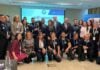
In order to combine experience and new work tools, the Customs Brokers Center of the Argentine Republic (CDA) has held a training seminar entitled “AI (Artificial Intelligence) in Foreign Trade”.
The activity, part of the celebrations for the 112th anniversary of the entity, had the close collaboration of the World Customs Organization (WCO), the International Association of Customs Professionals (ASAPRA) and the General Directorate of Customs (DGA).
In this context, on Thursday, August 15, 2024, various exhibitors from the country and abroad referred to aspects of this “disruptive technology” that is of interest for border management.
Following the opening of the seminar by the President of the CDA (Gerardo Pardal), the President of ASAPRA (Nelson Brens) and the General Directorate of Customs (Maximiliano Luengo representing Dr. Eduardo Mallea), the presentation of the Technical Officer to the Sub-directorate of Procedures and Facilitation of the World Customs Organization (WCO), Gordana Vidanovic, took place.
At the panel on “Preliminary results of the WCO 'Smart Customs' Project”, Gordana Vidanovic He referred to the World Customs Organization and the work carried out and ongoing work on disruptive technology.
As an international body, the WCO – explained Gordana Vidanovic – has a crucial role in facilitating legitimate global trade. It is made up of 186 members, divided into six regions. In order to fulfill its functions, it provides guidance and support to customs administrations. For this purpose, it focuses on delivering best practices that help modernize customs procedures. She commented that it provides technical assistance to its members according to their needs and provides tools to deepen customs cooperation.
With this approach, he presented the Study report on disruptive technologies (2022) which builds on the report published in 2019 and incorporates lessons learned and new experiences gained. In a spirit of collaboration between Customs and businesses, the WCO has done significant work in analysing 7 disruptive technologies. Namely: Blockchain technology, Internet of Things, Big Data and Data Analytics, Artificial Intelligence and Machine Learning, Biometrics, Drones, Augmented and Mixed Virtual Reality and 3D Printing. “These technologies are transforming the way Customs operate, enabling more precision and efficiency of their processes,” he said.
Additionally, the WCO Official referred to the ongoing work on disruptive technology, specifically to the project of "Smart Customs”, funded by China Customs. An important aspect of the project is a survey conducted to measure the global adoption of disruptive technologies among WCO members, identify capacity building needs and foster the exchange of experiences and best practices to update the Disruptive Technologies Study Report (2022). A total of 116 proposals were received from WCO members, where it was found that 92% of the cases have an information technology strategy. However, most of the responses were concentrated in the operational maturity (30%) and advanced (27%) levels, while the transformation level (7%) scored the lowest.
He recalled that artificial intelligence “is a field of computer science that focuses on the reaction of intelligent machines that function in a similar way to human beings.” AI Systems are based on data observed, collected and analyzed without the need to be programmed. It covers different technologies, deep learning, artificial vision, among others.
Currently, 12 WCO members have fully adopted AI. The adoption of this technology is contributing to improving customs performance, mainly in the areas of fraud detection and risk management. This allows for the automation of complex procedures, minimising errors, for example: classification of goods. However, “it presents challenges that require a robust technological infrastructure and specialised resources”, said Gordana Vidanovic.
Next, the topic on “Customs Brokers/Agents/Dispatchers and Artificial Intelligence in Foreign Trade” was very well developed by Marco C. Gold (Customs and Logistics 4.0 Specialist), who provided an adequate theoretical-practical framework for handling the “basic” language of this disruptive technology in customs management. It is worth noting the significant contributions provided by the speaker.
Later, the panel on “Innovation with Artificial Intelligence in Argentine Customs: opportunities and ongoing initiatives” was addressed by Maximilian Luengo (Director of the Customs Process Reengineering Department) and Santiago Tedoldi (Coordinator of the Committee on Innovation on Artificial Intelligence). Luengo quoted the words of Director Eduardo Mallea, who said that “Specialization and technical knowledge are key in the development of tasks”. Along these lines he added that “lArtificial intelligence has to be an ally in the work of both customs agents and assistants.”
After highlighting the mutual collaboration, Luengo explained the particularities of the actions proposed in the AFIP Strategic Plan 2022-2025 for the development of analysis systems with the application of artificial intelligence. He referred to the Committee for Innovation on Artificial Intelligence created in the General Directorate of Customs (General Resolution 16/2024).
He also said that the WCO has promoted capacity building in the exploitation of customs data, in particular with the BACUDA project (Band of Customs Data Analysts). Within this framework, Santiago Tedoldi was selected to specialize. He was awarded for his project “Prediction of customs fraud,” presented in this space.
The significant achievement was pertinent to his appointment as the titular Coordinator of the Innovation Committee on Artificial Intelligence, whose “holistic view” is intended to strengthen the public-private relationship. “All of this is to deter fraud and improve compliance, modernize and facilitate trade, as well as increase the efficiency of Argentine Customs,” Luengo said.
To this end, an interesting contribution was the ongoing initiative of the use of AI by the Argentine Customs, which included the intervention of Santiago Tedoldi. He made the General concepts referring to artificial intelligence as an instrument. “These are tools that complement and improve humans and improve the performance of processes; humans supervise and rectify the responses of algorithms, AI lacks the capacity to contextualize and solve challenges.”
From this, the detail of projects and initiatives Aimed at: 1) “Prediction of customs fraud” (applies to cargo manifests, detailed declarations, postal shipments, passengers), “Image processing” (photographic images, X-ray images, luggage, CCTV images), “Natural language processing” (Tariff classification, Customs Chatbot, specialized assistants) and “Forecast of trade variables” (collection by sector/complex, Operational Cargo and resource allocation).
“We are facing a unique opportunity for development and improved performance of the Argentine Customs; we have initiatives that propose a viable path and international cooperation is bearing fruit in terms of awareness and capacity building,” Tedoldi reflected.
And the fruitful morning ended with the presentation on the "Importance of the Customs Broker as a facilitator of Foreign Trade", by Enrique Loizo (Past President of the CDA), who in a spirit of cooperation welcomed the “recognition” given to the figure of the customs agent by the head of the General Directorate of Customs, according to the message read at the opening.
It is worth noting that all the panels were very well coordinated by the Argentine Oscar Horacio Dhers, who is Vice President of the Southern Cone Area of ASAPRA.
The seminar concluded with words of thanks to the attendees and the brilliant speakers, with mentions of the institutions that supported training in the use of artificial intelligence for more agile and secure trade.

You can learn more about AI in the WCO/OMC publications: “Study report on disruptive technologies” (2022) and the WTO/OMC Document “The role of advanced technologies in cross-border trade: a customs perspective "(2024)

Aduana News foi o primeiro jornal aduaneiro da Argentina a lançar sua versão digital. Com mais de 20 anos de trajetória, suas publicações e iniciativas têm como objetivo oferecer o conhecimento mais relevante sobre temas aduaneiros, contribuindo para a promoção do comércio seguro e da facilitação do comércio na região.