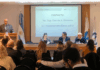
The Eighth Customs Law Conference concluded with great success this Wednesday, November 27, 2024 in Uruguay. The event, which brought together experts and professionals from the sector, focused on a highly relevant topic: “The tenth anniversary of the Customs Code of the Eastern Republic of Uruguay (CAROU)”. During the day, intense debates and analyses were held that highlighted the evolution of this code, which, although it has undergone some minor modifications in recent years, continues to be a key tool for the development of foreign trade in the country.
The event was opened by Cr. Jaime Borgiani, National Director of Customs, who highlighted that “This event is not limited to Customs nor does it seek to impose its vision, but is also enriched by the perspectives of the private sector and the contribution of leading experts.”. He also stressed that the main objective of these events is not only to benefit the attendees, but also to contribute to the development of the country through the topics discussed. Thus, the event, organized by the National Customs Directorate (DNA), was accompanied by a visual celebration that reflected the progress and achievements of the Customs Code throughout its decade of validity.
Panel I: General Aspects was in charge of Stanislaus Lamenza (DNA), who presented a presentation entitled “Background, current state and perspective of the Customs Code of the Eastern Republic of Uruguay.” During his speech, he highlighted that the CAROU, pointed out the evolution of the Customs Code, which emerged as a response to the fragmentation and outdated regulations based on laws from 1964 and 1970. Inspired by international models such as the MERCOSUR Customs Code and the Kyoto Convention, the CAROU consolidated the regulations into a single legal body, facilitating access and promoting legal certainty. It introduced innovations such as the regulation of customs violations considering the intention, the control of free zones and the incorporation of advanced technology, such as customs scanners. Over ten years, he said, the CAROU has proven to be adaptable to technological advances and has maintained a stable application, with few modifications. Dr. Lamenza concluded his presentation by emphasizing that, despite constant challenges, the CAROU remains as “A solid and modern tool, prepared to address the current and future needs of foreign trade«.
Then the Dr. Cecilia Alfaro, Head of the Legal Advisory Department of the DNA, addressed the topic “The innovative institutes of CAROU and their practical application”. In his speech, he stressed that CAROU continues to be a source of learning for all the actors involved, but underlined the importance of keeping it up to date in order to respond to the demands of a foreign trade that is constantly changing. In this regard, he stressed the importance of predictability and the balance between facilitation and control. Among the institutes mentioned, he addressed the secrecy of proceedings, special customs regimes, binding consultation and self-review, highlighting their sustained use since the implementation of the Code. However, he also acknowledged that some articles need revision to remain in tune with the transformations in foreign trade and the conduct of the sector. He concluded with a reflection on the importance of a fair legal system that balances stability and change. "A code that does not keep pace with reality risks becoming ineffective. It is our responsibility to ensure that these regulations continue to fulfill their purpose: facilitating trade and ensuring fairness.", finished
In that line, the Dr. Daniel Olaizola, representative of the National Institute of Logistics (INALOG), addressed the issue of the “Proposals for operational modifications to the CAROU after 10 years”, stressing that the regulations have fulfilled their main objectives. In this context, he presented a series of ideas aimed at the modernization and optimization of the CAROU, including: the incorporation of emerging technologies, such as artificial intelligence, guaranteeing transparency and respect for constitutional rights; the modification of the customs warehouse regime to optimize resources and increase revenue; the flexibility of temporary admission for cases of active improvement; the extension of the period for self-reporting of violations, encouraging voluntary regularization; the centralization of controls in primary areas under the management of the National Customs Directorate, with the aim of improving operational efficiency.Customs has demonstrated a remarkable capacity for growth and adaptation. It would also be interesting to explore innovative mechanisms such as single windows.".
Also, the Dr. Raúl González Berro, representative of the Association of Customs Agents of Uruguay (ADAU), offered an exhibition entitled «Issues to be reviewed 10 years after CAROU came into force. During his analysis, he highlighted both the achievements made and the areas requiring improvement, providing a historical perspective and constructive criticism on the regulations.
González Berro described the implementation of the CAROU as a significant advance for the Uruguayan customs sector, the result of a process that included academia, private operators and public institutions. However, he pointed out that the urgency in its preparation was due to the need to align with the Draft Customs Code of MERCOSUR (CAM), which limited the adaptation of the code to the specific needs of Uruguay. He stressed the importance of reviewing provisions that generate operational difficulties, such as temporary storage and legal availability of merchandise, as well as the lack of clarity in key terms such as "reshipment" or "reposition." In addition, he pointed out inconsistencies in the regulations on internal taxes and the need to adjust the regulation of minor customs violations, such as those related to excess baggage or tourist vehicles. He concluded that it is necessary to update the CAROU to eliminate limitations and facilitate customs processes.
La Lic. Fiorella Cagnone and Lic. Cecilia Burnalli (DNA) They addressed the issue of the “CAROU and the new MERCOSUR Origin Regime”, in force since July 18, 2024, after four years of intense negotiations. This regime, aligned with international best practices, incorporates key changes to modernize and streamline trade processes in the region.
Highlights include the simplification of origin requirements, the transition from certificates of origin to proofs of origin through self-certification, which increases the validity of these documents. In addition, the responsibility for verifying the origin of products is assigned to the customs of the member countries, which facilitates and centralizes control.
Another important change is the extension of the retention period for documents of origin, which is now extended to five years. In addition, procedures for free trade zones are made more flexible and corrections to the accreditation of origin are allowed, contributing to greater flexibility in customs procedures.
The fundamental objective of this regime is to offer greater transparency, agility and legal security to MERCOSUR commercial operators, while promoting more efficient and competitive integration within the bloc.

The following panel
Later, the issue was addressed Panel II: Infractional and Disciplinary Aspects, inaugurated by the Dr. Alejandra Lopez Siecola (DNA), who presented the topic: “Evolution of the disciplinary procedure for related persons.”
The lawyer addressed the innovations in disciplinary matters related to customs activity, highlighting the changes implemented in the current regulations, especially through the CARAU. These reforms include the creation of a new category of "people linked" to customs activity, which broadens the spectrum of regulated agents and improves control over their conduct. In addition, the range of sanctions applicable to customs brokers was expanded, who previously only faced suspensions, but can now be subject to fines, disqualification and other sanctions.
One of the main innovations was the hierarchical status of the customs agent, considering him an auxiliary agent of trade and of the public customs office, which increased his responsibility and suitability, directly affecting the disciplinary field. An increase in disciplinary procedures has also been observed since the creation of this new category, due both to the growth of customs operations and the expansion of regulations.
It was pointed out that administrative offences and disciplinary procedures, although regulated in the CARAU, have not undergone any major innovation since the previous regulations. Therefore, the need to reformulate and update the disciplinary offences and procedures was raised, with a focus on providing greater clarity and guarantees to both the clearing agents and the related persons. In addition, work is being done on a project to improve the procedure, making it more suitable and adequate for the related agents, which would guarantee more transparency and certainty in customs operations.
In conclusion, he stressed the importance of a clear regulatory framework and a well-defined disciplinary procedure to ensure integrity and ethics in customs operations, protecting both operators and the State itself.
In his speech, the Dr. Pablo Labandera He developed the topic “10 years after the CAROU came into force: More guarantees or more defenselessness for those under administration?”. Throughout his presentation, he provided constructive criticism of the changes and practical application of the CAROU, highlighting both its successes and areas that require adjustments.
Labandera began by explaining the historical context in which CAROU was approved, stressing that it was not a proactive initiative, but rather a response to complex situations, such as the approval of CAMP in MERCOSUR, where Uruguay was informed of decisions already taken. This context encouraged the creation of legal mechanisms adapted to the reality of foreign trade.
One of the first points to be highlighted was the concept of “customs territory”, which was redefined in the CAROU. Previously, there was a distinction between customs territory and political territory, especially in free trade zones, which created difficulties in terms of oversight. The CAROU clarified that there was only one customs territory, and free trade zones were treated as extraterritorial from a tax point of view. Based on this reconfiguration, a hierarchy was established in the customs control zones, with greater oversight powers in the primary zone and lesser powers in the secondary zone.
Labandera also mentioned that the CAROU allowed a reinterpretation of the general principles of rights in the customs field, although with some criticism. He points out that the customs administration has been more restrictive in the interpretation of principles such as proportionality and reasonableness, which has affected the guarantee of the rights of those administered. This point was linked to what he considers a tendency towards defenselessness in certain situations, since the interpretation of rights is stricter than it should be.
A central theme of his speech was the binding consultation, whose strict interpretation by the customs administration has gone against the original intention of the legislator, who sought greater certainty and predictability for foreign trade operators. Labandera advocated a broader interpretation that would allow those administered to access the guarantees provided for in the CAROU.
Finally, he addressed the issue of the time limits for self-review of irregularities, criticising the insufficiency of the 30 working days established to regularise situations. He proposed that the time limit should be extended by five years, considering that the detection of irregularities often takes longer, especially in multinational companies, which are the ones that usually correct these errors due to their internal policies.
Labandera reflected on the integration of artificial intelligence (AI) with customs law, highlighting a lack of clear regulations in this regard. He mentioned a recent report approved by the World Trade Organization (WTO), published on its website, which analyzes how AI impacts international trade. The report addresses the impact of AI on trade in goods and services.
WTO forecasts point to a possible increase in international trade, with a 14% increase in trade in goods by 2040, under a homogeneous implementation of AI in all countries. On the other hand, if the application is uneven or not optimal, this increase would be smaller, affecting less developed or developing countries more.
In summary, Labandera stated that, although the CAROU has represented an important advance in the modernization of customs practices, there are still areas that require reforms to ensure greater guarantees for those affected and avoid situations of defenselessness.
In his presentation, the Dr. Leonardo Bon (DGI) addressed key aspects such as “The fraud offence and its connection with smuggling”. The speaker underlined his specialisation in domestic tax law, particularly in the Tax and Customs Code, and mentioned significant advances in the Tax Administration, such as the implementation of the ex officio statute of limitations after more than 35 years. He also addressed the issue of non-binding consultations, allowing taxpayers to obtain positions from the Administration on certain issues without active legitimacy. Regarding tax fraud, he pointed out the difficulties in its application, especially in dangerous offences, and the issue of attempt. In addition, he reflected on the subjective responsibility of taxpayers in these cases and the possibility of applying cumulative sanctions in the tax and criminal fields. He also highlighted the importance of guaranteeing a fair and compliant judicial process, particularly in cases of tax fraud and smuggling, in which sanctions can coexist. Finally, he pointed out the quantification of taxes in the context of these crimes and the competence of the customs court to deal with these cases, highlighting the technical complexity and practical challenges in applying tax and customs legislation.
La Dr. Claudia Arriaga, In his presentation, he reflected on “Lessons and challenges for the Public Prosecutor’s Office from CAROU” over the last 10 years. Although he is no longer part of the Public Prosecutor’s Office, he detailed how this process transformed legal practice in the field, highlighting the need to adapt to new regulations and the implications of the technical knowledge acquired over time.
He highlighted the achievements of CAROU, such as the expansion and classification of concepts, the creation of new procedures (such as binding consultation and self-review), and the reorganization of the infraction regime. However, he also mentioned certain shortcomings and criticisms, such as the lack of effective use of binding consultation, the risk of legal uncertainty for clearing agents, and the need for greater flexibility in the application of the customs process, particularly in the exercise of the prosecution.
Arriga said that, although no significant changes have been proposed by the Prosecutor's Office, the possibility of replacing the customs process with a civil one in certain cases was discussed, which did not prosper. He also commented on the interpretation of the Code in the courts and the importance of redefining the role of the complainant in the investigative hearing.
Finally, he highlighted improvements in the enforcement of sentences and liquidations, although he suggested that there are still areas that could benefit from adjustments to make the system more efficient and equitable.
Thus, the event came to closure with the words of gratitude of Dr. Stanislao Lamenza, of the National Customs Directorate, who highlighted the support of the public and private sectors for the realization of the seminar, as well as the effort of the Legal and Communications Division, which facilitated the participation of more than 400 people. The Director Jaime Borgiani, for his part, stressed: «I am delighted by the quality of the exhibitors and the commitment they demonstrated. Each presentation was marked by genuine interaction, aimed at continuous improvement. This is the way to encourage the exchange of ideas between the private sector and public institutions, as we all seek to ensure that Customs and the State function in the best possible way.«.
Finally, the next Customs Integration and Transparency Conference was announced, which will take place on December 9th starting at 9 a.m. The event will also be held virtually.

Aduana News foi o primeiro jornal aduaneiro da Argentina a lançar sua versão digital. Com mais de 20 anos de trajetória, suas publicações e iniciativas têm como objetivo oferecer o conhecimento mais relevante sobre temas aduaneiros, contribuindo para a promoção do comércio seguro e da facilitação do comércio na região.