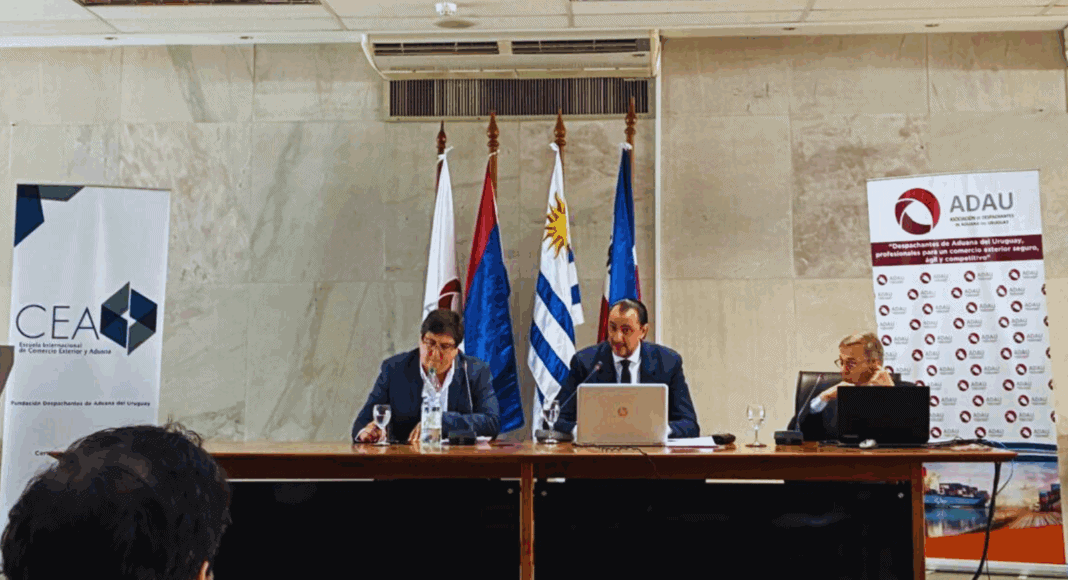

The year 2025 was marked by intense academic activity in customs matters. December, the month associated with Christmas and New Year's Eve, witnessed the XII Academic Conference on Customs Law in Uruguay. The event took place on December 12th, organized by the Faculty of Law of the University of the Republic, at the headquarters of ADAU – the Uruguayan Association of Customs Brokers – in Montevideo, with the central theme: “Fundamental issues regarding Customs ValuationThe conference featured five thematic areas, each comprised of exhibitors from different countries.
They were inaugurated by the Dr. Santiago Berrondo, on behalf of Mr. Joaquín Serra, The National Director of Customs, who was unable to attend in person due to commitments in Argentina, was present. Berrondo emphasized: “Forums like this, where we can engage in open intellectual debate, provide an opportunity to strengthen our knowledge and professionalize customs practices.” He stressed that academic training in customs law is fundamental in a context of constant transformation of foreign trade and the increase in illicit activities linked to organized crime. Reinforcing the importance of legality, he noted: “All of this creates a scenario that compels us to stay updated and prepared.”
He then took the floor Gabrielle Gambaro Lestuzzi (Uruguay), president of ADAU and recently elected president of ASAPRA. He noted that the conference, with the participation of specialists from Argentina, Brazil, Peru, and Colombia, reflects the event's relevance in customs law. This edition, focused on "Customs Valuation," promotes "transparent and efficient foreign trade aligned with international best practices." Gambaro emphasized that the conference is "free and accessible to all stakeholders in the sector," including members, students, professors, and the community connected to ADAU and ASAPRA.
El Dr. Andrés Varela, The event's general coordinator closed the opening with words aligned with the pluralism established by his predecessors, reinforcing the nature of the conference.
5 Panels
To address the central theme, “Customs Valuation,” the event was organized into five panels. As a reminder, customs valuation is the procedure used to determine the value of goods in order to arrive at the taxable base necessary for applying an ad valorem duty to imports or exports.
This concept, with regard to imports, is based on Article VII of the General Agreement on Tariffs and Trade (GATT), which established the basic principles of an international valuation system, laying the foundations for transparent and uniform foreign trade among member countries by setting rules and moving away from arbitrary criteria.
Some details of the panels:
On first panel, el Dr. Pablo González Bianchi (Uruguay) addressed one of the key points regarding value, namely the "condition of sale," analyzing when such a condition is met and in what cases it affects the value of the merchandise. For its part, Dr. Julio Carlos Lascano (Argentina) addressed the value adjustment and its effect, starting from the payment of royalties, which constitute a condition of sale, highlighting the jurisprudence on this issue. Given that the payment of royalties is a condition of sale, and especially who can impose this condition and how, to fulfill the requirement of Article 8, paragraph 1 c) of the Valuation Agreement, are the main questions that have garnered jurisprudence attention. Dr. Andres Varela (Uruguay) addressed the need for certainty in customs valuation reviews, considering that the search for the material truth is part of the administrative procedures that may lead to the determination of value. The panel was moderated by Dr. Marcelo Sica.
On second panel, moderated by Dr. Pedro González Bonino (Uruguay), the discussion focused on the current challenges of customs valuation in Argentina, presented by the Dr. Juan Patricio CotterThe renowned Argentine academic highlighted the need for clear procedures and precise guidelines to provide greater certainty in determining the value of goods. He also emphasized the importance of avoiding additional costs arising from delays due to customs observations, noting that in Argentina goods can be released under a guarantee regime as a mechanism to mitigate risks and expedite operations. Subsequently, the Dr. Pablo Labandera (Uruguay) highlighted the importance of achieving legal certainty in customs valuation, observing, in practice, various problems that arise in the possibility of properly determining value, and considering the need to address issues in light of new challenges that influence the value of goods. At the close of the panel, the Dr. Renata Amarante (Brazil), referred to transfer pricing and its effects on customs valuation, highlighting the issues that arise today in the Brazilian context, for which it emphasized cases that addressed this particular topic.
After a break, the day continued with the third panel, focused on the fundamental concepts of customs valuation. Dr. Claudio Augusto Gonçalves Pereira (Brazil) addressed customs valuation in imperfect markets. Next, the Accountant Fabiana Fernández (Uruguay) analyzed the valuation methods established in the GATT Agreement, focusing on the primary rule of transaction value and the need for adjustments in accordance with Article 8. Finally, the Dr. Lorena P. Bartomioli (Argentina) examined the element of time and its relevance in determining value, highlighting the aspects that customs authorities consider essential for its application. The panel was moderated by Andrés Varela.
El fourth panel was moderated by Marcelo SicaIt began with the presentation of Dr. Ricardo Pretelt (Colombia), who addressed “royalties” and “license fees” in customs valuation, highlighting the critical considerations that arise when determining the value of these elements. Next, the Dr. Raúl González Berro (Uruguay) presented its analysis of official estimated prices and their impact on customs valuation. The panel concluded with the Dr. Julio Guadalupe (Peru), who examined the value adjustments derived from royalties, license rights and advertising expenses, evaluating how these concepts can be considered or excluded to achieve a correct recomposition of value.
El fifth panel, again moderated by Andres VarelaIt began with the Dr. Guillermo Felipe Coronel (Argentina), who addressed customs offenses and infractions arising from customs valuation. He pointed out that, in criminal proceedings, it is essential to differentiate between the initial presumption of guilt and any discrepancies that may arise from the customs service, emphasizing the need for a degree of objective certainty to achieve a possible conviction, and he analyzed criminal procedures in matters of crime and infractions. Next, the Dr. Marcelo Sica (Uruguay) focused its presentation on the iCustoms violations for smuggling motivated by valuation, highlighting various cases that illustrate specific situations observed in investigations within Uruguayan jurisdiction. The panel concluded with the Dr. Harry Schurig (Argentina), who highlighted, from the perspective of customs valuation, the relevance of the autonomy of Customs Law, supporting his analysis with the various legal and technical elements that underpin it.
With this, the XII Academic Conference on Customs Law closed the year 2025, offering a space for professional updating and leaving open the invitation for the 2026 edition, without specifying the date.

Aduana News foi o primeiro jornal aduaneiro da Argentina a lançar sua versão digital. Com mais de 20 anos de trajetória, suas publicações e iniciativas têm como objetivo oferecer o conhecimento mais relevante sobre temas aduaneiros, contribuindo para a promoção do comércio seguro e da facilitação do comércio na região.