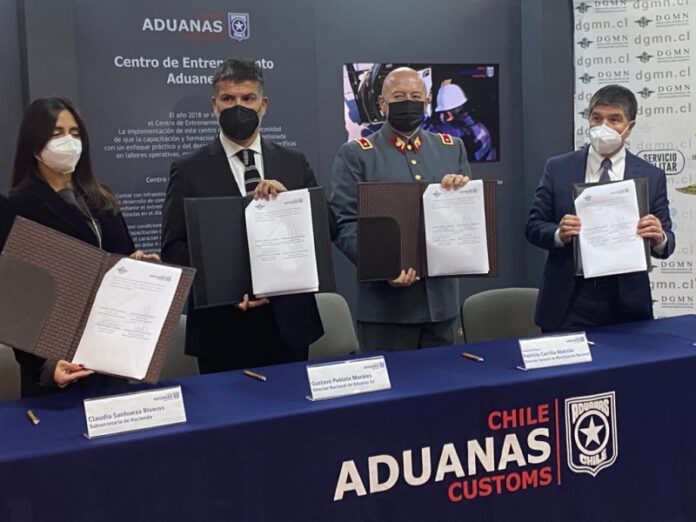
As part of concrete governmental and multi-sector efforts to combat arms trafficking in Chile, the National Customs Service and the General Directorate of National Mobilization (DGMN) of the Army They signed last week a agreement This will allow for even more thorough inspections to prevent the smuggling of weapons, ammunition and their parts through packages arriving at the courier and postal areas at Santiago International Airport.
According to the official communication, the strategy instrument signed on Monday ((25.07.2022) establishes that a DGMN specialist gunsmith provides technical support to the inspection work carried out daily by Metropolitan Customs officials to find weapons or their parts, and determine with certainty whether or not “the elements” found correspond to elements controlled or prohibited by Law No. 17.798. In addition to the above, the gunsmith may instruct Customs personnel regarding the general characteristics that allow them to distinguish between controlled or prohibited items and those that are not.
The important operational working document was signed at the Customs Training Center (CEA) by the National Director of Customs (s), Gustavo Poblete, and the General Director of National Mobilization, Brigadier General Patricio Carrillo Abarzúa, together with the Undersecretary of the Interior, Manuel Monsalve, and the Undersecretary of the Treasury, Claudia Sanhueza.

For this purpose, Customs, every time it identifies a suspicious operation during the review of packages or shipments, especially in the Courier zone (fast shipping) or postal zone (Correos de Chile), will contact the DGMN expert to provide the information and coordinate the joint inspection and the required expert reports. Permanent training and updates by the DGMN to customs officials are also considered to strengthen their capabilities to detect this type of products.
El Undersecretary of the Interior, Manuel Monsalve, he stressed in this regard: “what you see here, the Armed Forces, the Director of the DGMN, the Director of Customs, the Undersecretary of Finance, is the State institutions working together to protect the security of Chilean men and women. That is what the agreement we are signing today implies.”
“Many of the people who see us in their homes are unfortunately victims of shootings in their neighborhoods, they feel intimidated or are victims of a crime where firearms are used and they wonder what the State institutions are doing to protect them. Well, this signing of the agreement shows that the agencies have the public safety of citizens as their first priority,” he added.
Meanwhile, Undersecretary of the Treasury, Claudia Sanhueza, stated that “It is essential to strengthen the role of the National Customs Service, which has played a historical role in detecting the decrease in tax evasion and which, therefore, has been considered in the tax reform to be strengthened both in its human resources and in technology and its assets associated with that; and part of this strengthening has to do with the new functions that are essential for the good performance of the entire country.”
“Customs has emphasized the work of intelligence and data analysis, which is capable of generating successful results in the control of illegal or dangerous goods, including weapons, ammunition and weapon parts, contributing to the protection of citizens by safeguarding authorized air, sea and land crossings. In this case, the capacity of Metropolitan Customs officials stands out, who carry out profiling work in the Postal and express delivery companies sectors,” explained the official. National Director of Customs (s), Gustavo Poblete.
The top customs authority explained that “today we are signing a collaboration agreement between the DGMN and the National Customs Service within the framework of a network of public institutions that are dedicated to the fight against organized crime. This is an agreement that seeks to generate an operation that allows us, jointly, to identify parts and pieces of weapons that could be entering Chile as contraband.”
Poblete also argued that “this will require that experts from the DGMN can support us in the retentions that we are going to carry out at the Santiago airport and at all the control points that are legitimately open throughout the country. This is an important step forward in the work that we want to do in this area.”
El Brigadier General Patricio Carrillo, Director of the DGMN, pointed out that “this is a collaboration agreement that is related to putting our capabilities at the service of what Customs does, particularly, the DGMN will provide gunsmiths who will train Customs personnel to teach them to identify parts and pieces of elements that are controlled by Law 17.798, on Arms Control, and that can illegally enter the country. It is a way of cooperating, as DGMN, in the detection of certain illegal acts that are occurring in Chile and that affect us all.”
This signature is part of the coordinated work carried out by Customs with police, armed forces, prosecutors, other ministries and services, as well as international organizations, where the exchange of information and participation in various working groups and specialized units to combat organized crime stand out, such as the Weapons Control Unit announced by the Ministry of the Interior in May.

The above, added to the intensive use of non-invasive media As the scanner and the experience of the officers have enabled various seizures and retentions of different weapons and parts to be carried out.
Data on operations and retentions
Customs figures for all Chile, in the field of security, show that between the year 2019 and June 2022 299 specific procedures have been carried out where they were seized 1.531.418 units of various types of products, including 1.042 firearms and blanks, 28.457 ammunition, 29.357 parts or pieces and 1.387.641 fireworks units.
With regards to Metropolitan Customs, which has under its jurisdiction the inspections carried out at the Santiago International Airport and the loads that arrive through it, from January to June of this year They have already seized 1.997 units of these products. In the San Antonio Customs This same amount amounts to 39.725 while in the Valparaiso Customs have been seized 2.230 units.

relevant cases
1. Iquique Weapons Case, July 2021: Following the discovery of weapons in Paraguay in a vehicle imported from Iquique to that country, the Risk Analysis Unit of the Iquique Regional Customs Office reviewed foreign trade movements and managed to identify 3 containers from New York, USA, with transshipment in Panama, whose import declarations indicated that they were transporting a total of 10 cars, a motorcycle and accessories for used cars.
The scanner truck and physical inspection confirmed that two vehicles in one of the containers had hidden contraband containing multiple parts and pieces to assemble around 2 AM-30 Multi Cal rifles, Anderson Manufacturing Hebron brand. They were found inside false bottoms, doors and tool boxes, among other parts of the vehicles.
2. Weapons case under courier review in Santiago, March 2022: : Metropolitan Customs officials inspected packages in the Courier area and detected unusual densities in a package from United States, which declared it contained “Parts of machines and mechanical devices.”
The alert determined that a physical examination of the cargo be carried out, and it was found that the contents corresponded to three shotguns and a rifle, all Keltec brand. Inside the same box was found the invoice from the foreign supplier, in which the weapons were described in detail. According to the document, the value reached US$3.
The importer is a gunsmith who, after what was discovered by Customs, was subsequently investigated by the Pudahuel Prosecutor's Office and the PDI, detecting his link with a former policeman in whose house a real arsenal of 47 weapons was found.
3. Antofagasta Airborne Weapons Case, July 2022: The Risk Analysis Unit of the Antofagasta Customs selected for review the air cargo imported by a company based in Iquique, coming from Miami, who entered the country through the Antofagasta airport, and then continued their journey by land to their final destination in the Tarapacá Region.
Customs inspectors carried out a documentary check of the import, which was recorded as “general cargo” transport. However, when they began to inspect the boxes, they found that hidden among dozens of packages of different sizes containing clothing, technology and accessories were parts and pieces for assembling high-caliber weapons.
Antofagasta customs officials inspected more than 80 boxes of packages over several days, in which they found not only weapon parts and pieces, but also other illicit or undeclared goods, classifying the crime of smuggling.
Regarding weapons, 16 holographic sights of the Westlake and Holsun brands were found; 6 folding stocks; 10 levers to prepare rifles; 5 rifle frames, 8 5.56 mm caliber rifle barrels; 9 rifle handguards with rails and accessories, 5 firearm grips, 5 plastic 9 x 19 mm caliber Glock magazines and various parts, pins, safeties and tools for assembly.
5. Retention of blank-firing weapons under new regulations of the Weapons Law, March 2022: 960 blank-firing pistols (96 boxes, weight: 1.320 kilos) were seized, of 13 different models, replica type, most of them 9 millimeters, manufactured in Türkiye, within the framework of the implementation of new legal provisions on adaptable blank-firing weapons, within the framework of the update of Law 21.412 on Arms Control. This progress was achieved thanks to a working group convened in 2021 with Carabineros de Chile, DGMN, PDI and the National Customs Service, in order to develop joint proposals to advance more effectively in the fight against crimes committed with firearms.
In this context, inspectors from the Metropolitan Regional Customs Office identified the shipment of an importer who received the blank-firing weapons in the midst of the promulgation and implementation of the new regulations, so a physical inspection and subsequent retention was carried out, since they were of the “Leo” brand, which is expressly prohibited by the new regulations.
The law prohibits the sale of blank-firing weapons that are more susceptible to transformation due to their similarity with conventional weapon models, the caliber of their ammunition, their operating mechanisms, etc. These are the following 10 brands: Bruni (BBM), Ekol, Zoraki, Blow, Leo, Kusey, Carrera, Ceonic, ISSC, and Kimar. In the case of brands not mentioned, it is indicated that only those that comply with the specific purposes authorized by law may be registered and marketed: professional canine training, control of harmful fauna, public shows, filming and performing arts, or other similar purposes.

Aduana News foi o primeiro jornal aduaneiro da Argentina a lançar sua versão digital. Com mais de 20 anos de trajetória, suas publicações e iniciativas têm como objetivo oferecer o conhecimento mais relevante sobre temas aduaneiros, contribuindo para a promoção do comércio seguro e da facilitação do comércio na região.