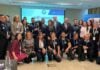
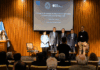
The National Customs Service of Chile held the webinar for two days “National Customs Tariff, 2022 edition”, an online seminar aimed at presenting the main new features contained in the nomenclature that is key to facilitating foreign trade flows in the country and the world, bringing together an average of 400 people who work in customs agencies or companies related to international logistics, other public services and customs officials from Arica to Punta Arenas.
La National Director of Customs, Alejandra Arriaza, was in charge of starting this important activity, highlighting in her words that “this is an ongoing work that never ends and in these days we want to comment, talk, make known and share together the openings that were made, how they impact, how they are worked on and also, why not, start talking about the needs for the future.”
Through a series of detailed presentations by the Professionals from the Classification Unit of the Technical Department of the Technical Subdirectorate of CustomsThe main aspects of the 2022 National Customs Tariff were announced, its origin, the modifications and the long preparation process that began in 2017, involving arduous work of dialogue between Customs around the world led by the World Customs Organization (WCO).
The new National Customs Tariff came into force on January 1, 2022, with a total of 351 sets of WCO amendments governing more than 95% of world trade during its five years of validity, and is based on the International Convention on the Description and Coding of Goods of the World Customs Organization (WCO), better known as the Harmonized System (HS). This nomenclature has been used in Chile since 1990.
At the close of the two days of exhibitions, the Technical Deputy Director of Customs, Gabriela Landeros, explained the importance of the Customs Tariff for all public and private actors linked to foreign trade and the generation of public policies, stating that "I hope that all attendees have been able to take full advantage of this event, a lot of learning, so that we can continue collaborating today more than ever to promote and facilitate legal trade, count on us for that."
At the national level, the Customs Tariff incorporates the requirements and needs of various public entities to facilitate the monitoring of foreign trade statistics, as well as the control of certain goods, among other objectives. Suggestions and proposals were received from organizations such as the Ministry of Culture, Arts and Heritage; Ministry of the Environment; National Fisheries and Aquaculture Service (SERNAPESCA); Office of Agricultural Studies and Policies (ODEPA); Public Health Institute of Chile (ISP); Agricultural and Livestock Service (SAG); Superintendence of Electricity and Fuels (SEC); National Forestry Corporation (CONAF); Chilean Nuclear Energy Commission (CCHEN); National Directorate of National Mobilization of Chile (DGMN) and the National Institute of Statistics (INE).
Some of the highlights are new openings in environmental issues, such as ozone-depleting substances and electrical and electronic waste; in the area of technological development, machines for additive manufacturing (3D printers) and unmanned aircraft (drones) as well as smartphones are appearing.
In the health area, changes were made to identify Zika virus diagnostic kits, cell cultures and new tobacco products, among others. There is also the elimination of positions due to low trading volume, among other matters.

Aduana News foi o primeiro jornal aduaneiro da Argentina a lançar sua versão digital. Com mais de 20 anos de trajetória, suas publicações e iniciativas têm como objetivo oferecer o conhecimento mais relevante sobre temas aduaneiros, contribuindo para a promoção do comércio seguro e da facilitação do comércio na região.