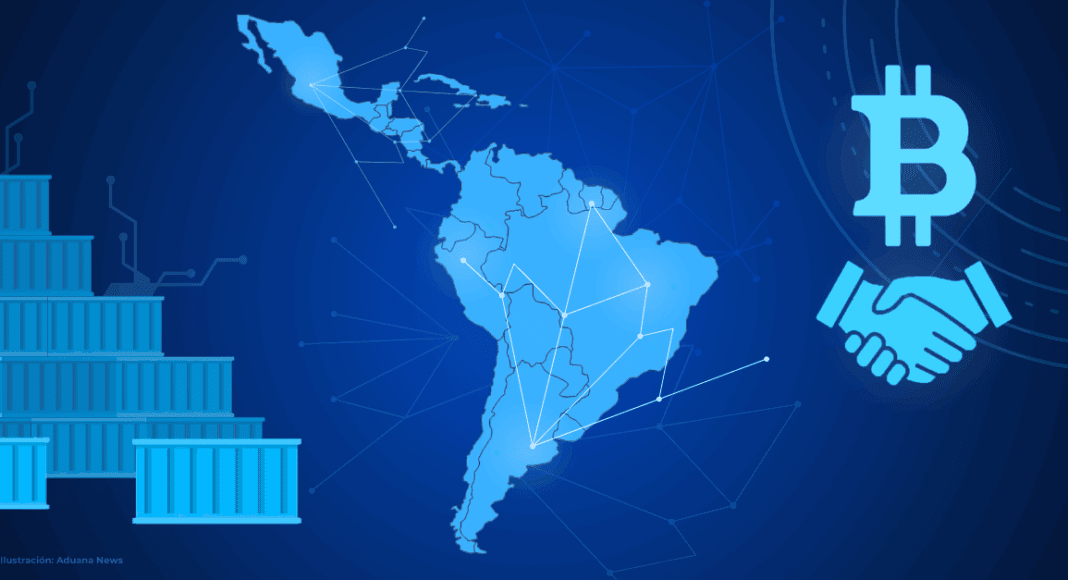

Fraud, delays, lost paperwork, redundant procedures, and processes that navigate through parallel channels without inter-institutional coordination. Although it may seem like something from another era, this is still the reality of much of foreign trade in Latin America. In a global context that demands speed, traceability, and legal certainty, the region continues to operate under rigid bureaucratic structures that erode its systemic competitiveness. However, an emerging technology promises to radically transform this landscape: Blockchain.
Blockchain's disruptive potential lies in its ability to generate immutable, auditable, and shared digital records among multiple parties in a commercial transaction. Certificates of origin, phytosanitary licenses, electronic bills of lading (e-BL), commercial invoices, letters of credit, and import permits can be stored and verified in real time, without the need for intermediaries, eliminating the risks of document forgery, data loss, or ex-post alterations. The experience of countries such as Singapore and the United Arab Emirates, which have incorporated Blockchain into their national foreign trade platforms, demonstrates that this is not an abstract technological promise, but a concrete tool for system transformation.
In fact, the most recent Regional Trade Agreements (RTAs), such as the CPTPP, the RCEP, the DEPA, and the EU-Singapore Digital Partnership, already include specific provisions on digital interoperability, the use of distributed technologies, the recognition of advanced electronic signatures, and the development of interoperable electronic single windows. This regulatory evolution reflects a new phase in the legal architecture of global trade, which not only seeks to eliminate tariffs or simplify rules of origin, but also to provide the system with technological mechanisms that guarantee efficiency, traceability, and predictability. Digital trade facilitation is thus consolidated as a new standard of governance.
In Latin America, where document flows often continue to circulate in paper form or as digital files via email, the adoption of blockchain represents a strategic opportunity to close structural gaps. A system where customs, health agencies, banks, and exporters access a single, synchronized and validated record from the source enables the automation of critical processes, such as certificate ratification, cargo release, and cross-border payments. The incorporation of smart contracts—self-executing programs that are activated when certain contractual conditions are met—introduces an automation logic that minimizes human intervention, reduces time, and eliminates operational friction. This phenomenon has been referred to in various international forums as a "silent revolution" in trade facilitation.
However, for this revolution to be effective and scalable, some institutional challenges must be overcome. First, regulatory adaptation is required to recognize the functional and evidentiary equivalence of electronic documents issued and stored using Blockchain technology. This entails adapting national legislation on foreign trade, customs, commercial law, and procedural law. Second, it is essential to advance the technical training of public officials and private operators, as well as to guarantee the interoperability of systems at the regional level. The creation of sandboxes regulatory, the standardization of technological interfaces and the signing of Mutual Recognition Agreements (MRAs) between competent authorities are key steps in that direction.
The main obstacle is not technology—which is already available and proven—but rather institutional fragmentation and the lack of cross-border digital governance. The region needs to move toward building a regulatory and operational ecosystem based on the principles of openness, security, technological sovereignty, and cooperation. In this sense, regional agreements must go beyond the letter and consolidate themselves as effective platforms for digital integration in pursuit of trade facilitation.
Furthermore, Blockchain's relevance goes beyond its operational impact. It also represents an opportunity to strengthen institutional integrity. In contexts where customs corruption, regulatory discretion, or smuggling undermine trust in the system, having a distributed, auditable, and transparent registry can be a powerful tool for strengthening the rule of law. Blockchain, in this sense, is not just a technological tool: it is a vehicle for governance and transparency.
Modernizing foreign trade is not just an economic necessity. It is a requirement for the political, legal, and institutional sectors. Latin America faces a historic opportunity to align its trade processes with global best practices. What is at stake is not just an improvement in logistics costs. It is the possibility of integrating into 21st-century trade under conditions of equality, legality, and trust.

| Ana Basco is Director of Insight LAC. She is an economist and political scientist from the University of Buenos Aires (UBA) with more than 20 years of professional experience in the fields of sustainable development, regional integration, and technological transformation. Her postgraduate studies in Regional Integration and International Business from institutions in the United States and Europe have allowed her to develop a global and strategic vision to drive Latin America's transformation toward a more integrated and sustainable future.
Throughout her career, Ana has held key roles in international organizations such as the Inter-American Development Bank (IDB), where she led the Institute for the Integration of Latin America and the Caribbean (INTAL). In this role, she led multidisciplinary teams and promoted research and cooperation on trade, regional integration, artificial intelligence, and sustainable development. As an academic, Ana teaches courses on economic, human, and social development at the university level and has published numerous studies, articles, and books on regional integration, sustainable trade, the digital gender gap, and the Fourth Industrial Revolution. Her work has contributed to strengthening the links between academia and the development cooperation agenda. |

Lautaro M. Ramirez is a lawyer, holds a Master's degree in Latin American Integration and is a specialist in integration policies from the National University of La Plata. He holds a diploma in trade and environment from American University, Washington DC, and a postgraduate degree in "Law, Economics, and Politics in Comparative Perspective: European Union and MERCOSUR" from the University of Bari, Italy.
In the Argentine Public Sector, he served as Technical Advisor to the Ministry of Agriculture of the Nation, in the negotiations of the MERCOSUR-EU Agreement (2009-2010), to the Ministry of Production of the Nation for compliance with the WTO case DS438: Argentina - Measures affecting the import of goods (2015-2016), Director of Commerce of the Province of Buenos Aires (2017-2018) and advisor to the Agency for the Promotion of Investments and Foreign Trade. He served as Rapporteur of the Foreign Trade Commission of the Honorable Chamber of Deputies of the Province of Buenos Aires (2019-2021).
In the international arena, he has served as a legal advisor and consultant to various international organizations on regional economic integration and market access, such as ALADI, OAS, IDB-INTAL, SELA, and WTO, among others. He teaches undergraduate and graduate courses in Argentina and abroad. He is the head of the consulting firm L3comex and an associate at Insight LAC.