






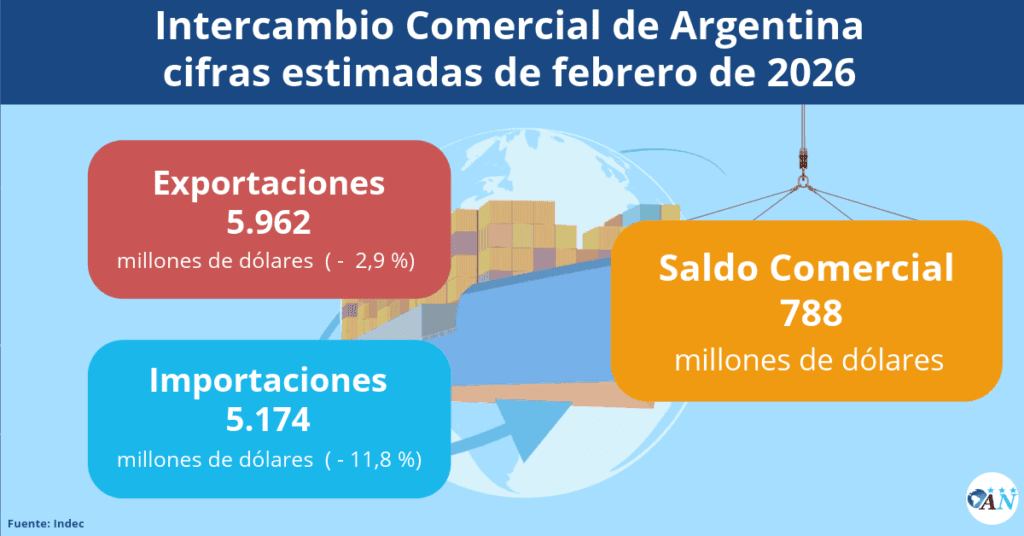
According to the National Institute of Statistics and Censuses (INDEC), Argentina's trade balance registered a USD 788 million surplus, which implied an increase in USD 513 million (186,5%) compared to the same month in 2025. However, the positive balance showed a 64% drop compared to the surplus achieved in January of this year, which had been USD 2.189 billion.
In this way, Argentina strung together 27 consecutive months with a surplus in its trade balance, although with a lower level of dynamism than observed in previous periods.
In this context, total trade—measured as the sum of exports and imports—reached USD 11.137 billion in February, representing a year-on-year decrease of 7,2%, according to official data. This performance was explained by the combined evolution of exports and imports during the period.
Exports
Exports totaled USD 5.962 billion, which represented a drop of 2,9% compared to the same month in 2025. This result was explained by a 7,1% decrease in the quantities exported, partially offset by a 4,4% increase in prices.
In terms of value, the items Those showing growth were primary products (PP) (+8,2%), driven by higher export volumes (+15,4%) despite lower prices (-6,2%), and manufactured goods of industrial origin (MOI) (+8,6%), favored by higher prices (+27,3%), which offset the drop in volumes (-14,5%). Conversely, manufactured goods of agricultural origin (MOA) decreased by 10,1%, due to lower export volumes (-15,8%), partially offset by better prices, while fuels and energy (CyE) registered the largest drop (-27,6%), affected by both prices and volumes.
As for destinationsSales increased to China (+67,6%), the European Union (+16,9%), and Paraguay (+0,3%). In contrast, exports decreased to the United States (-5,7%), Brazil (-12,5%), India (-5,4%), and the Middle East (-35,8%).
Imports
Imports totaled USD 5.174 billion, representing a year-on-year decrease of 11,8%.This result was explained by a 14,9% decrease in imported quantities, partially offset by a 3,7% increase in prices, with reductions in all economic uses.
Amongst the economic usesThe largest declines in value were recorded in fuels and lubricants (CyL) (-36,8%), followed by parts and accessories for capital goods (PyA) (-24,9%) and capital goods (BK) (-17,6%), a result mainly associated with a sharp reduction in imported volumes and, in the case of fuels, also with lower international prices. In terms of quantities, the largest decreases were observed in PyA (-29,4%) and BK (-22,9%), reflecting lower demand linked to productive investment. Meanwhile, consumer goods (BC) showed a moderate decline (-3,0%), while passenger motor vehicles (VA) decreased by 5,7% in value due to lower prices, despite a slight increase in quantities (+1,5%).
As to the origin Of the imports, external purchases from Brazil (-18,7%), as well as from China (-14,7%), the European Union (-17,5%), the United States (-18,5%), India (-34,8%) and the Middle East (-46,6%), decreased, reflecting a generalized contraction in import demand.
Cumulative result
In the first two months of the year, Argentina accumulated a trade surplus of USD 2.977 billion, with exports of USD 13.208 million and imports of USD 10.231 million.
Thus, the trade surplus was sustained in a context of less dynamic trade, explained mainly by the contraction of imports and a moderate export performance.

Aduana News foi o primeiro jornal aduaneiro da Argentina a lançar sua versão digital. Com mais de 20 anos de trajetória, suas publicações e iniciativas têm como objetivo oferecer o conhecimento mais relevante sobre temas aduaneiros, contribuindo para a promoção do comércio seguro e da facilitação do comércio na região.








