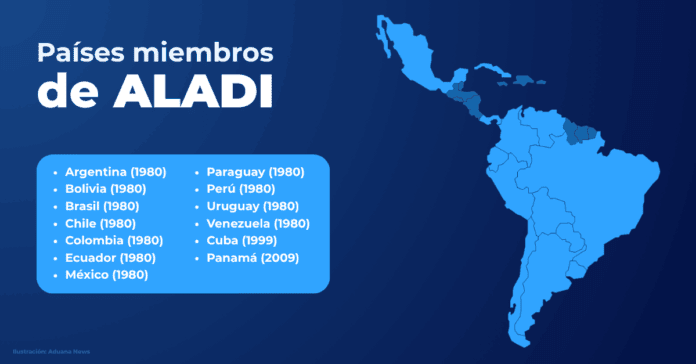
In times of increasing reconfiguration of international trade, geopolitical tensions and acceleration of the digital agenda, a diagnosis by the Latin American Integration Association (ALADI) once again focuses on one of Latin America's main weaknesses: the low effective use of existing trade integration tools.
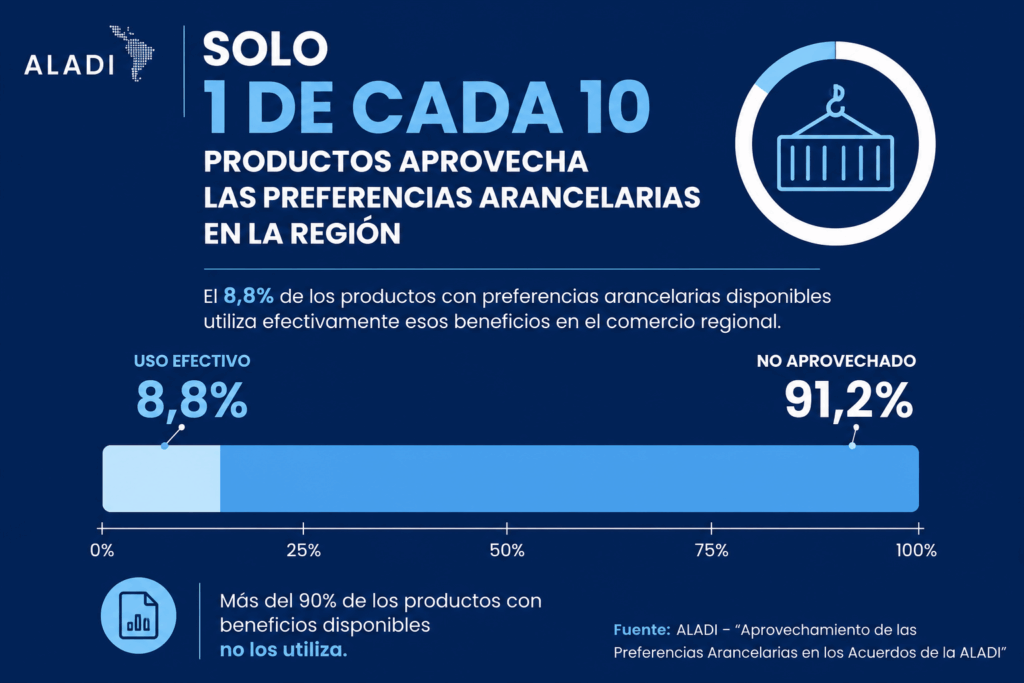
The 20-page report, which he accessed Aduana News, warns that only the 8,8% of products with available tariff preferences effectively utilize those benefits in regional trade. The study, titled “Taking Advantage of Tariff Preferences in ALADI Agreements”, shows that barely one in ten products that could be traded with tariff advantages currently takes advantage of these instruments.
Wide coverage, low utilization
The finding is especially relevant considering the broad coverage of ALADI's network of agreements. According to the study, approximately 80 % of the products can circulate in the region without paying tariffs or with reduced tariffs thanks to preferences negotiated between the member countries, representing around 85% of regional trade.
However, the problem lies not only in the existence of agreements, but in their effective use.
The report argues that, even when preferential coverage exists, many products fail to take advantage of it because structural and operational factors. These include the lack of exportable supply or effective demand, difficulties in complying with rules of origin, logistical costs, lack of awareness of agreements, and the persistence of non-tariff barriers.
The analysis also shows strong differences between countries. Brazil, Argentina, and Panama register the highest levels of preferential utilization, while Cuba and Venezuela show minimal levels. Meanwhile, Bolivia, Paraguay, and Uruguay stand out for the broad coverage of their agreements, in contrast to economies where the preferential network is more limited or selective.
Also exist marked differences at the sectoral levelIndustrial sectors with higher added value—such as textiles, ceramics, metals, and machinery—show better levels of utilization of tariff preferences, while primary products continue to face greater structural constraints.
Reduced usage and pending challenges
The study also provides another piece of data that deserves attention: the regional utilization of preferences fell from 9,9% in 2015 to 8,8% in 2021. Among the causes cited are the progressive reduction of tariffs Most Favored Nation (MFN) and the growing weight of China in regional trade, whose share of Latin American imports went from 19% to 22% during that period.
Meanwhile, intraregional trade continues to represent only around 12% of the region's total trade, reflecting persistent difficulties in consolidating regional value chains and deepening productive integration.
The diagnosis takes on even greater relevance because it coincides with the results of the 2025 Global Trade Facilitation SurveyThis analysis was also conducted by ALADI in conjunction with ECLAC. According to this survey, Latin America and the Caribbean still lag behind the most efficient economies, especially in key areas such as the comprehensive digitization of procedures, the electronic exchange of documents, and the interoperability of single windows for foreign trade.
Beyond the numbers mentioned, the study shows one of the region's main weaknesses: Latin America has numerous trade agreements, but has not yet managed to translate them into greater regional trade.
In this sense, ALADI's diagnosis reinforces one of the main challenges of trade facilitation: making information, coordination and transparency more effective so that existing agreements translate into greater regional trade. The following chart aims to contribute to the understanding of countries' potential in this area.
See the study “Utilizing Tariff Preferences in ALADI Agreements” https://www2.aladi.org/biblioteca/Publicaciones/ALADI/Secretaria_General/SEC_Estudios/254.pdf

Aduana News foi o primeiro jornal aduaneiro da Argentina a lançar sua versão digital. Com mais de 20 anos de trajetória, suas publicações e iniciativas têm como objetivo oferecer o conhecimento mais relevante sobre temas aduaneiros, contribuindo para a promoção do comércio seguro e da facilitação do comércio na região.