Food supplements of foreign origin with supposed energizing and antibiotic properties were seized by inspectors of the National Customs Service at the Quillagua outpost in northern Chile. The merchandise was hidden in a truck that was transporting fruits and vegetables from Arica to Antofagasta.
The detection was recorded during the controls carried out on the loads leaving the Tarapacá region and allowed the seizure of a total of 1.926 bags that were inside 20 boxes that simulated being vegetables. These are goods of foreign origin and contain active ingredients that require health authorizations because they contain ingredients that are typical of pharmaceutical products.

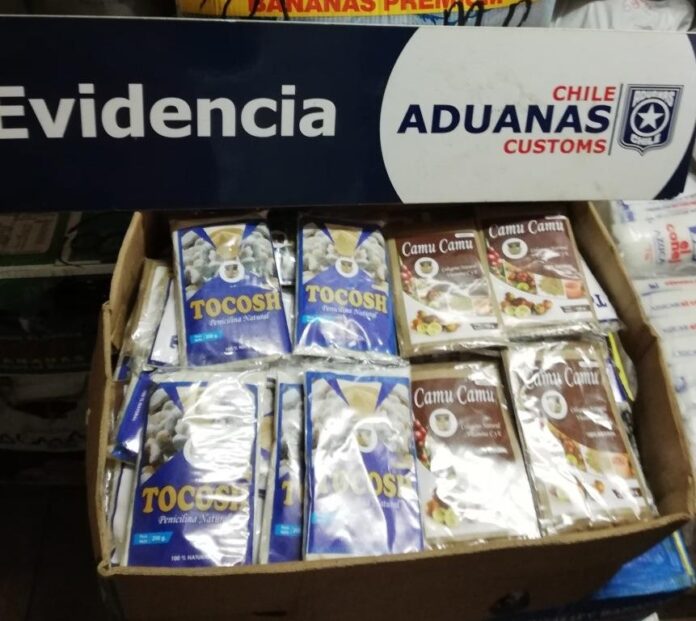
Boxes with undeclared merchandise. Photo: Chilean Customs
The procedure began when a Chilean driver arrived at the checkpoint and presented his cargo manifest, which indicated he was transporting 29 thousand kilos of onions, sweet potatoes, caiguas, potatoes, noodles, rice, mangoes, papayas, beans and passion fruit. After that, he was inspected with Non-invasive technology and X-rays alerted of the presence of merchandise that did not match what was declared.
Based on the above, the cargo was ordered to be unloaded and under hundreds of fruits and vegetables it was possible to find 20 cardboard boxes that contained a total of 1.806 bags of maca powder of 250 grams each, 60 bags of collagen flour of 200 grams each and 60 bags of 200 grams each of “Tocosh Natural Penicillin” flour.
The Regional Director of the Iquique Customs, Cristián Molina Silva, He explained that since the products were not declared, were hidden and did not have documentation proving their legal importation, they were seized and the transporter was charged with the crime of smuggling. "This type of procedure, in addition to attacking tax evasion, seeks to bring security to the community., since although there are food supplements that are recognized by international scientific literature, there are also manipulations or inappropriate use of pesticides on crops. That is why the Public Health Institute requires its analysis to authorize its commercialization in Chile”, Agregó.

Aduana News is the first Argentine customs newspaper to launch its digital version. With 20 years of experience, its publications and initiatives aim to provide the most relevant knowledge on customs issues in order to contribute to safe trade in the region.