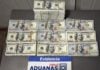
The General Director of Aduana, Guillaume Michel, specified this Thursday (04.08.2022/1.250/XNUMX) that a “first universe” of over- and under-invoicing operations in foreign trade was detected for “around USD XNUMX billion in FOB value”, in addition to irregularities in the companies that availed themselves of precautionary measures.
irregular operations that allowed companies Obtain more dollars to operate in foreign trade of those that would have corresponded to them cover from the beginning of 2021 to the present.
Michel's statements are in line with those made by the Minister of Economy, Sergio Massa, when he indicated that "there are more than 13.000 triangular import operations from 722 companies that bought products at one price, sent them to another destination and brought them back to Argentina at an overpriced price. In general, triangulation was done with companies that were no more than a year old."
Yesterday, in his first appearance as minister, Massa stressed that "a registry will be opened for 60 days so that companies can make a rectification," but warned that "complaints will be made to the Argentine justice system against those who do not come forward to clarify or rectify, but a complaint will also be made to the United States money laundering unit, since banks from that country were used and therefore the headquarters of the financial domicile determines jurisdiction."
Customs Actions
Along the same lines, Michel clarified today that “Triangulation itself is not something irregular, it is common in foreign trade that the merchandise comes from one place and is invoiced from another country."But he specified that "what we are analyzing here are triangulation operations where the merchandise comes from one country and the invoice is from another jurisdiction, but over-invoiced; that is, at a price higher than what the merchandise is worth."
Specifically, he stressed that “we detected an initial universe of 13.640 operations involving 722 companies, for around US$ 1.250 billion in FOB value. We have already reported some of these to the Argentine justice system.”
Combating this type of maneuver would help increase the level of reserves of the Central Bank (BCRA), which currently stand at US$ 37.818 billion, and was one of the main objectives outlined by Massa in his presentation yesterday.
Over- and under-invoicing in foreign trade means that companies obtain more dollars to carry out their operations than they should have.
Michel warned that the increase in the exchange rate gap generates greater profits (and incentives for) in this type of operations, “both the over-invoicing of imports to obtain dollars in the country at the official exchange rate and then exchange it abroad to the financial dollar, as well as the under-invoicing of exports where the tax base in Argentina is hollowed out to leave the dollars abroad.".
Regarding the imports made possible through precautionary measures, the head of Customs said that "we are electronically notifying all those companies that were able to access the exchange market and imported through precautionary measures, where we detected some type of irregularity."
“In some cases, Customs has detected precautionary measures that a company obtains and then transfers the trademark to a third company for a very short period of one month, in order to be able to use that precautionary measure and be able to obtain the merchandise,” Michel added.
One of the intentions of Customs is to avoid this type of fraudulent conduct in the future: “Beyond working case by case, We are trying to generate a perception of future risk to try to correct future conduct in these operations where the goal is to get dollars out of the country that we should apply to production and employment and not for this financial gain.", Michel said.
Among the measures analyzed, Massa yesterday anticipated the implementation of a foreign trade traceability system, which will allow for better control and transparency over the use of foreign currency, so that from the authorization and until the release of foreign currency, there will be a deadline, date and authorization, with priority for the productive and health chains.
The official exemplified this type of operation with the detection, by Customs, two weeks ago of a "crude maneuver" where the import of video cards was declared in the Special Customs Area of Tierra del Fuego when, in reality, they were low-value products without integrated circuits, commonly known as "electronic waste."
"Only aluminum plates were imported, where the merchandise had no more value than the weight of the aluminum," he said.
Michel also mentioned a case of under-invoicing of lithium exports by a company in the north of the country.
Finally, and with the aim of “dismantling this type of maneuvers,” he said that Customs is working together with AFIP to improve “the capacity for data analysis,” as well as “the exchange of international tax information” with other countries.
Source: Telam

Aduana News foi o primeiro jornal aduaneiro da Argentina a lançar sua versão digital. Com mais de 20 anos de trajetória, suas publicações e iniciativas têm como objetivo oferecer o conhecimento mais relevante sobre temas aduaneiros, contribuindo para a promoção do comércio seguro e da facilitação do comércio na região.