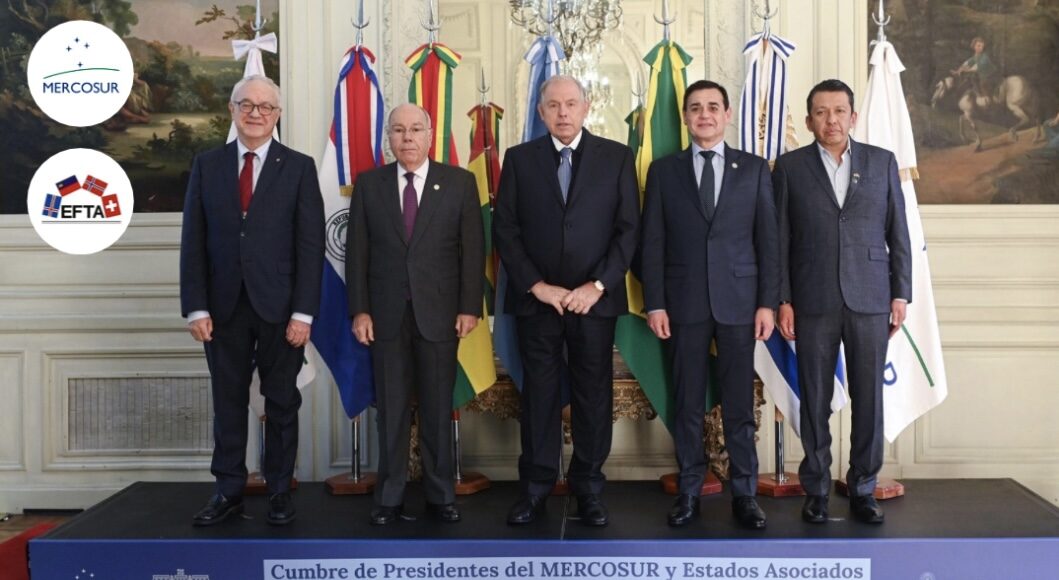

The recent consensus reached between the Member States of the Southern Common Market (MERCOSUR)—comprised of Argentina, Brazil, Uruguay, and Paraguay—and the European Free Trade Association (EFTA)—which includes Switzerland, Norway, Iceland, and Liechtenstein—represents a significant opening toward sophisticated consumer segments. It not only eliminates tariffs on almost 97% of bilateral trade but also incorporates modern disciplines such as cumulation of origin, public procurement, environmental sustainability, and health requirements. In this sense, the agreement goes beyond trade in goods and includes services, investment, intellectual property, digital commerce, and logistics facilitation. The text also covers a wide range of sectors: intellectual property, trade defense mechanisms, and sustainable development. It also includes provisions for customs facilitation and institutional cooperation, facilitating integration into regional and global value chains.
Negotiations formally began in January 2017 following the signing of a joint declaration that concluded the exploratory phase. The first round took place in June of that year in Buenos Aires, followed by successive meetings in Geneva and other capitals of the States Parties. Throughout 2018 and 2019, key aspects such as trade in goods, rules of origin, services and investment, intellectual property, and public procurement were addressed. The substantive conclusion of the negotiations was announced in August 2019. A legal review meeting was subsequently held in Buenos Aires in February 2020. Delays inherent to internal processes were overcome with renewed political momentum in 2022 and successive technical rounds in 2024 and 2025. Finally, in April 2025, all outstanding chapters were closed, allowing for signature and opening of the ratification process.
Accessing the EFTA market represents a strategic opportunity for products originating in MERCOSUR, not only due to the dismantling of tariffs, but also due to the qualitative added value this region offers. These are economies with high purchasing power, demanding in terms of quality, sustainability, and traceability, where consumers prioritize differentiated products with certifications of origin, ethical production, and low environmental impact. Exporting to EFTA not only implies higher prices per unit sold, but also reputational positioning, access to premium channels, and the possibility of establishing stable business relationships with reliable partners in a clear and predictable regulatory environment. For companies based in MERCOSUR countries, this means a gateway to high-value segments where competition is not based solely on price, but also on identity, innovation, sustainability, and trust.
The agreement also opens up diversified opportunities for Argentine companies. In the agroindustrial sector, SMEs that already export can take advantage of preferential quotas on products such as meat, honey, wine, and fruit to enter or expand their presence in sophisticated markets such as Switzerland, where per capita income exceeds USD 80.000 and demand is oriented toward high-value-added goods and differentiated standards. Furthermore, the trade facilitation and origin accumulation chapter allows Argentine logistics operators to offer specialized services such as multimodal transport, traceability, and refrigeration, adding value at every step of the export chain. Furthermore, the opening of the public procurement market in EFTA countries enables Argentine technology, services, and engineering companies to compete for institutional contracts in demanding but still underexplored markets such as Norway and Switzerland, consolidating a broader and more sophisticated internationalization strategy.
Unlike the agreement with the European Union, which faces internal political complexities within the European bloc, the commitment to EFTA faces less resistance and promises a more expeditious entry into force. This will allow Argentine companies to plan ahead to take advantage of the negotiated preferences, including tariff, regulatory, and origin provisions.
Following the technical conclusion of the negotiations, the agreement must undergo formal steps: legal scrubbing, official signature by the governments, and then parliamentary ratification in accordance with the constitutional procedures of each State Party. Once at least one country from each bloc has ratified the treaty, it can enter into force provisionally, pending full ratification by all members.
In the meantime, Argentine companies can begin preparing by identifying goods with competitive advantages and negotiated quotas—such as honey, exotic fruits, or frozen fish; establishing alliances between exporters and logistics operators to optimize compliance with origin and quality requirements; developing regulatory capabilities (ISO, certifications) to participate in public procurement; and even planning a geographically diversified internationalization that considers EFTA as a complementary avenue in the event of possible delays with the European Union. Thus, the Mercosur-EFTA agreement is positioned as a concrete and timely tool for repositioning Argentina's exportable offering in a competitive and segmented global landscape.

Lautaro M. Ramirez is a lawyer, holds a Master's degree in Latin American Integration and is a specialist in integration policies from the National University of La Plata. He holds a diploma in trade and environment from American University, Washington DC, and a postgraduate degree in "Law, Economics, and Politics in Comparative Perspective: European Union and MERCOSUR" from the University of Bari, Italy.
In the Argentine Public Sector, he served as Technical Advisor to the Ministry of Agriculture of the Nation, in the negotiations of the MERCOSUR-EU Agreement (2009-2010), to the Ministry of Production of the Nation for compliance with the WTO case DS438: Argentina - Measures affecting the import of goods (2015-2016), Director of Commerce of the Province of Buenos Aires (2017-2018) and advisor to the Agency for the Promotion of Investments and Foreign Trade. He served as Rapporteur of the Foreign Trade Commission of the Honorable Chamber of Deputies of the Province of Buenos Aires (2019-2021).
In the international arena, he has served as a legal advisor and consultant to various international organizations on regional economic integration and market access, such as ALADI, OAS, IDB-INTAL, SELA, and WTO, among others. He teaches undergraduate and graduate courses in Argentina and abroad. He is the head of the consulting firm L3comex and an associate at Insight LAC.