






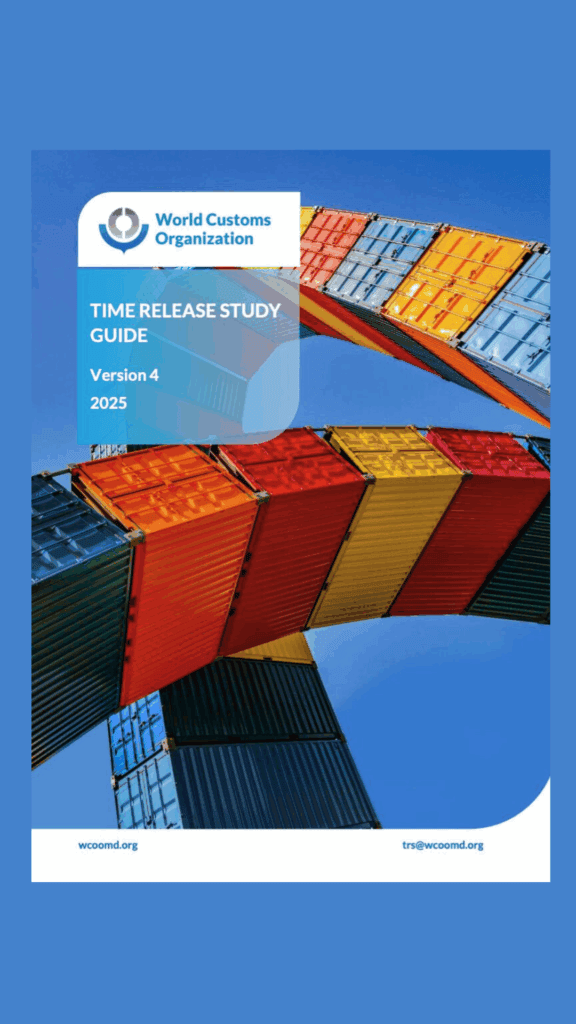
The World Customs Organization (WCO) presented the Fourth edition of the Time Release Study (TRS), Considered by the WCO itself as one of the most important tools for strengthening border efficiency and facilitating international trade. This study constitutes a unique method for measuring the actual performance of customs activities within the framework of trade facilitation at borders, evaluating the effectiveness of procedures applied by customs and other regulatory bodies during import, export, and transit operations of goods.
The ETD allows for accurate measurement of these processes and provides information for decision-making, with the aim of improving operational performance and guiding effective reforms. But what does this new version 4 contribute? What diagnosis emerges from its analysis, and what good practices can be extracted? These are the questions addressed in this note. Aduana News.
Trade facilitation: a priority
The WCO maintains that “agile and efficient international trade remains an essential driver of economic development and global integration.” General Secretary, Ian Saunders, affirms that "One of the WCO's ongoing priorities is to accelerate the movement of legitimate goods by modernizing, simplifying and harmonizing customs procedures.To achieve this, the organization promotes international standards and practical tools that strengthen business environments.safe, predictable and transparent"at bilateral, regional and multilateral levels.
Mr. Saunders further emphasizes that “lThe ETD Guide, developed over 25 years ago and last updated in 2018 (Version 3), was revised again in 2025 with the publication of Version 4.. While maintaining the globally accepted methodology for measuring the time from arrival to physical release of goods, this update "reinforces the WCO's strategic commitment to supporting its Members in the effective implementation of the WTO Trade Facilitation Agreement."
Argentina: an opportunity to move forward
It is worth remembering that the WTO Trade Facilitation Agreement (TFA) entered into force on February 27, 2017, and Argentina acceded to it at that time. It is required to comply with Article 7.6 on "Release and Clearance of Goods," which includes establishing and publishing release deadlines. This obligation reinforces the importance of the TRS as a tool for measuring and optimizing clearance times and ensuring transparency in trade transactions.
As recently highlighted in an article by Master's degree holder Gustavo Scarpetta, "trade facilitation tools represent a concrete opportunity for Argentina to improve its competitiveness and efficiency at its borders. The creation of a National Trade Facilitation Committee, with effective participation from the private sector and under the guidelines of the WTO and WCO, is a low-cost, high-impact measure."
"In a world where speed, coordination, and transparency are crucial, not having this body means jeopardizing our competitiveness and delaying the reforms needed to optimize customs processes and trade flows." (available here: https://aduananews.com/argentina-necesita-un-comite-nacional-de-facilitacion-del-comercio-una-urgencia-estrategica/)
What Version 4 brings
Continuing with the OMA update, version 4 introduces significant changes that make the TRS more comprehensive and effective. Among its key innovations:
- Whole-of-border approach: expands the scope of the study beyond Customs, integrating other border control agencies.
- Inclusive participation: involves both the public and private sectors in all phases of the study and strengthens the role of National Trade Facilitation Committees.
- Advanced methodological tools: allow for more reliable and comparable data to be obtained.
- Platform for dialogue and continuous improvementThe guide transforms the TRS into a space for cooperation that accelerates trade flows, strengthens supply chains, and promotes sustainable economic growth.
Digging deeper, version 4 reveals 8 key pillars:
- Strategic planning: defines clear objectives and responsible roles, aligned with trade facilitation.
- Improved methodology and process mapping: Identify bottlenecks and responsibilities using process diagrams and a risk-based approach.
- Data collection and sampling: combines quantitative and qualitative data with statistical techniques that ensure representativeness.
- Preparation and pilot tests: ensure smooth implementation and reduce interruptions during study.
- Comprehensive data analysis: includes verification, harmonization, segmentation, and outlier handling to draw practical conclusions.
- Visualization and communication: makes it easier to understand results through clear graphs, diagrams and charts.
- Implementation and monitoring: Uses SMART indicators and RACI matrix to support sustainable improvements and continuous monitoring.
- Efficiency and impact: reduces delays and redundancies, promoting data-driven decisions and measurable improvements in customs clearance.
Global good practices
The WCO emphasizes that the updated guide drew on the experiences of its Members on different continents, incorporating specific lessons learned at the global level:
- Americas
- Chile: The TRS was implemented to improve coordination between Customs and health agencies for maritime exports of aquaculture, fisheries, and forestry products. In 2016, the study determined an average clearance time of 6,24 days and highlighted the need to standardize information between Customs and ports.
- Guatemala: Launching the Integrated Modernization Program (MIAD) in 2019, it implemented the methodology at key land border crossings for intraregional trade. Thus, its first TRS identified bottlenecks and enabled the development of a 2020-2023 National Action Plan, implemented by inter-institutional teams and supervised through a tracking matrix. At the regional level, it led the first TRS for the Central American Pacific Corridor, optimizing 13 border crossings and promoting economic integration. This initiative was carried out while the Central American country held the WCO Regional Vice Presidency for the Americas and had the support of SIECA.
- Chile: The TRS was implemented to improve coordination between Customs and health agencies for maritime exports of aquaculture, fisheries, and forestry products. In 2016, the study determined an average clearance time of 6,24 days and highlighted the need to standardize information between Customs and ports.
- Pacific Asia
- Australia and New Zealand: They improved the interoperability of electronic systems in maritime and air trade.
- India, Indonesia, Japan and Laos: They used the TRS to promote regulatory reforms and the digitalization of customs processes.
- Australia and New Zealand: They improved the interoperability of electronic systems in maritime and air trade.
- Africa
- Cameroon, Mauritius and Sudan: They made progress in inter-institutional coordination to accelerate the movement of goods and reduce commercial costs.
- Cameroon, Mauritius and Sudan: They made progress in inter-institutional coordination to accelerate the movement of goods and reduce commercial costs.
- Middle East and Eastern Europe
- Saudi Arabia and Georgia: They integrated private actors into decision-making to strengthen their trade facilitation strategy.
- Saudi Arabia and Georgia: They integrated private actors into decision-making to strengthen their trade facilitation strategy.
WCO Statement
That said, we would like to highlight the words of Ian Saunders, Secretary General of the WCO: "The revised Guide is not only a technical manual, but also a tool for collaboration, dialogue, and continuous improvement. By leveraging it, Members can advance Customs modernization and the integration of all border agencies..
And not to be mere words: these new data show how much remains to be done. The WCO's 130-page update, with nine appendices and 9 figures, is available on its official website and is ready to help optimize trade across borders and strengthen integration.
- https://www.wcoomd.org/-/media/wco/public/global/pdf/topics/facilitation/instruments-and-tools/tools/time-release-study/wco-time-release-study-guide–version-4-2025.pdf?db=web
.

Aduana News foi o primeiro jornal aduaneiro da Argentina a lançar sua versão digital. Com mais de 20 anos de trajetória, suas publicações e iniciativas têm como objetivo oferecer o conhecimento mais relevante sobre temas aduaneiros, contribuindo para a promoção do comércio seguro e da facilitação do comércio na região.








