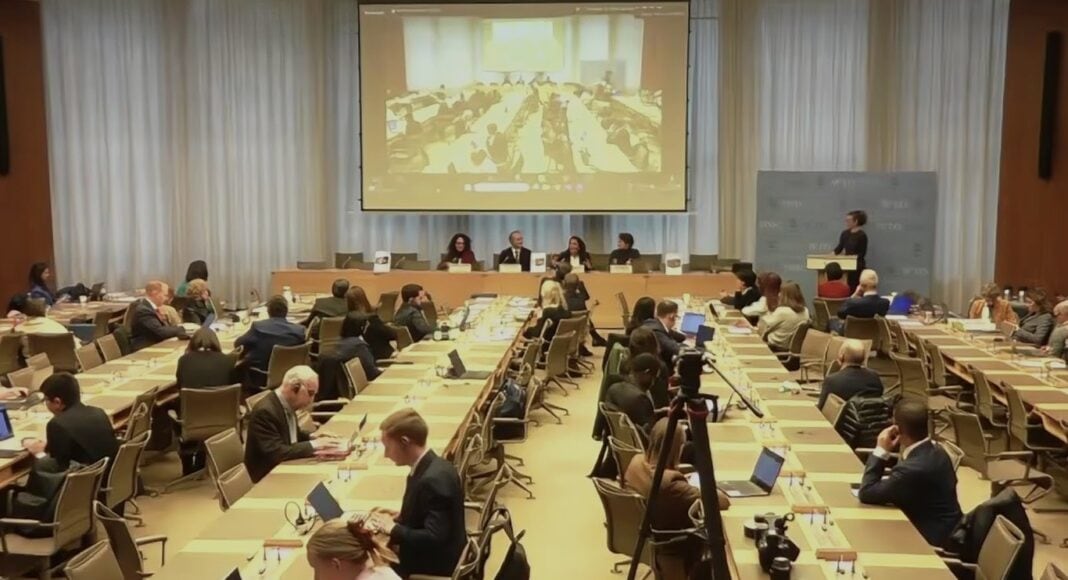

In a panel held on Thursday (21.11.2024) by the World Trade Organization (WTO), international experts analyzed how artificial intelligence (AI) can assist in customs procedures and positively impact agriculture. Arti Gobind Daswani, Trade Policy Analyst -WTO- He opened the debate by highlighting how AI can optimize customs processes, strengthen supply chains and contribute to food safety.
Valentina Ferraro, Project Manager Smart Customs of the World Customs Organization, He commented that this project is geared towards disruptive technologies, with a particular focus on artificial intelligence (AI), cloud computing and blockchain. He stressed that - in the field of AI - the agricultural sector has great potential to benefit from the same AI applications as other sectors, provided that these solutions are properly implemented in the customs administrations of member countries.
However, “everything will depend on the scope of the AI projects and the level of collaboration between customs and other relevant agencies,” he stressed. Broadly speaking, the application of AI can be grouped into categories. Some administrations focus on service delivery, seeking to speed up responses. On the other hand, the automation of repetitive tasks, such as document matching, is a key application. In addition, he stressed the strengthening of analytical capabilities, especially in relation to the detection of technical issues.
“If we want to be more specific and focus on the agricultural sector, we could propose a tool for classifying goods, a crucial aspect when products cross borders.” He also suggested implementing a system to manage quotas, which is also of great importance for this sector.
On the other hand, Ferraro commented that the application of the single window is a measure promoted for facilitate compliance with sanitary and phytosanitary requirements agricultural products. However, its implementation depends on the maturity of each system and must be evaluated on a case-by-case basis.
The WCO representative clarified: “Not all administrations have the same level of development in the single window, nor the same degree of collaboration with other organizations at the borders.”
“However,” he continued, “the implementation of smart systems has been crucial in several countries to address challenges in the area of food and plant security. He cited prominent examples, such as that of China, where the use of advanced technologies has made it possible to effectively combat fraud in food safety, an issue of great relevance to both public health and international trade. United States, the move towards more precise traceability is being facilitated by inter-institutional collaboration between various government agencies, which ensures better supervision and control of imported and exported products.
And in Brazil, The Ministry of Agriculture has implemented artificial intelligence for risk management, an initiative that not only optimizes internal processes but also integrates efficiently into the single window. “This integration contributes to safer and more agile management, improving the security of foreign trade and reducing waiting times at customs.”
In risk managementArtificial intelligence also plays a crucial role, especially in areas such as image recognition. Other applications within the main areas of improvement identified are the rapid clearance of goods and the optimization of technical skills in customs processes.
Ferraro, with other examples, illustrated some concrete benefits that artificial intelligence is generating in customs. A prominent case is that of the customs of Hong Kong, where the user experience has been improved. In Indonesia, for example, a decrease in the number of complaints has been observed. Also, in Ecuador a significant reduction in dispatch times has been achieved.
The panel was joined by Eva Siegener, Researcher at DG SANTE of the European Commission, and Vincent Martin, Director of the Innovation Office (IN) of the Food and Agriculture Organization of the United Nations (FAO).
Their presence marked the shared inter-institutional commitment in this area, within the framework of the WTO conference and the presentation of the report "How AI shapes and is shaped by international trade", broadcast via zoom.
You can access the report.

Aduana News foi o primeiro jornal aduaneiro da Argentina a lançar sua versão digital. Com mais de 20 anos de trajetória, suas publicações e iniciativas têm como objetivo oferecer o conhecimento mais relevante sobre temas aduaneiros, contribuindo para a promoção do comércio seguro e da facilitação do comércio na região.