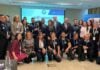
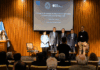
Last Wednesday (25.10.2023), at the headquarters of the Customs Brokers Center of the Argentine Republic (CDA), the book “The World Customs Organization: Past, Present and Future” Written by Dr. Héctor Hugo Juárez Allende, judge of the National Tax Court and professor specializing in customs issues.
The special edition, sponsored by ASAPRA together with the CDA, is an initiative to disseminate in a comprehensive, organized and synthetic manner the enormous contributions that this prestigious and recognized institution has been making for the safe growth of global foreign trade.
The extraordinary work published by the Tirant Lo Blanch group brings together the introductory comments of the Deputy Secretary General of the World Customs Organization (WCO), Mtro. Ricardo Trevino Chapa, as well as the copious information that the author has collected in the course of his research and the contributions received from numerous experts in the field.
At the opening of the event, the Vice President of the CDA, Andrea F. Coscarello, thanked the attendees for their presence and provided details of the initiative.
"This is reflected in the structure of the book," added the President of ASAPRA, Nelson Brens. It is an enriching read for "the new generations."
Then, Maria Luisa Carbonell, An international affairs specialist at the General Directorate of Customs, he highlighted the "seriousness of the research" to learn about the history, present and future of the WCO, whose agenda aims to explore technological innovations that can help customs.
For his part, the representative for Argentina, Chile, Paraguay and Uruguay of the Tirant Lo Blanch Publishing House, Mr. Patricio Rojas Olmedo, issued a statement regarding the editorial aspects of the work and its importance within the company's catalogue.
Later, the former head of the WCO's Fraud and Facilitation Directorate, Ana Hinojosa (online from the USA), spoke in very complimentary terms regarding the author and the importance of the book for the dissemination of the enormous work carried out by the institution in its 70 years of existence.
When his turn came, Dr. Hector Juarez Allende He referred to and thanked the support of the numerous specialists who shared their knowledge to make the research possible. He particularly thanked his translators into English (Lic. Andrea Paz) and French (Lic. María Teresa Rivas), who are also specialists in customs matters, and his editorial designer and layout artist (Lic. Marcelo Jourdan), who is particularly relevant to the aesthetics of the book, the content of which is presented in 18 easy-to-read chapters.
The author presented the Meeting structure y the performance of the WCO, an independent intergovernmental organization made up of the world's customs administrations. He clarified that "the private sector is not a member, but it has an institutional representation within the organization's structure and a very important participation."
He pointed out that the headquarters The WCO headquarters is located in Brussels, the capital of the Kingdom of Belgium (Europe). It was established in 1952 with the “purpose of ensuring the highest degree of autonomy and uniformity in its customs systems.” Its values are mutual aid or cooperation, responsibility, democratic attitude and equity.
In order to fulfill its functions, the strategic objective Its mission is to provide leadership, guidance and support to customs administrations, and from the perspective of its members it has three central objectives: trade facilitation, revenue collection and protection of society, in that order.

Currently, the WCO has 185 membersThe designated official languages are English and French. Although there is -according to Juárez Allende- a pilot plan to incorporate other additional languages (Arabic, Portuguese, Russian and Spanish) in order to improve its positioning in relation to other International Organizations: UN, WTO and EU.
The author recalled the historical basis of the organism: the First meeting as a Customs Cooperation Council took place on January 26, 1953 with 17 members.
He also referred to Organizational chart respective. He didactically explained the structure of the Council (supreme body that meets once a year) and the Secretariat (permanent body responsible for managing and directing the daily operations of the WCO).
The author highlighted that "the International Organization is changing the work system," giving relevance to disruptive issues linked to innovation and technology where "data" will be fundamental in the future.
He affirmed the extraordinary progress of the OMA with the formation of the Private Sector Advisory Group The WCO was established in 2005 to receive information and advice on Customs and International Trade issues from the perspective of the private sector (importers, exporters, customs brokers and other operators). "This wealth of experience and knowledge enhances the contributions of the WCO, since its instruments, standards and guidelines can address a variety of activities within the supply chain and the complexity of international trade," he said.
Also, Juárez Allende highlighted the legal instruments with which the WCO works. He focused on the Regulatory Framework safe, The Customs Act was adopted in 2005 to explain that this international instrument determined a paradigm shift: there is no longer a tiered view (importing country / exporting country); instead, an attempt is made to guarantee security throughout the entire process of movement of goods, from the exporter's factory to the importer's warehouse, focusing on traceability and security throughout the logistics chain, recognizing the importance of a closer association between Customs and companies. Since then, figures such as Authorized Economic Operators (AEO) have been created and are expanding worldwide.
Among the foreign trade operators who work with customs services, he referred to the relationship of the WCO with the customs brokers, which are strongly represented within the Private Sector Consultative Group through ASAPRA and the International Federation of Customs Brokers Associations (IFCBA).
In parallel, the author developed procedures which refer to the «facilitation« of legitimate global trade, without neglecting the proper "control" over its operations; these are two fundamental factors for the growth of countries. In this regard, he pointed out that the WCO aims for customs to stop being an executive body for the economic policies of governments and become a consulting body. Why? "Because customs handle foreign trade information."
The book develops the Capacity building of customs agents based on integrity, as well as the packages and instruments (more than 130) that the WCO provides to customs. It also includes research and evaluation of customs and Agency performance, essential elements along with digital development and data development.
At the end of the text, the following is incorporated: WCO Future Agenda, chapter that examines new technologies and their impact on customs activity.
In conclusion, Héctor Juárez closed his presentation with the words "dream come true": currently, since 15.09.2021/XNUMX/XNUMX, two copies of the book The World Customs Organization: Past, Present and Future (one in Spanish and one in French) are displayed in the prominent showcase located in front of the Kyoto Hall at the Agency's headquarters.
A wonderful initiative to make the knowledge of the global customs community reach more people.


Aduana News foi o primeiro jornal aduaneiro da Argentina a lançar sua versão digital. Com mais de 20 anos de trajetória, suas publicações e iniciativas têm como objetivo oferecer o conhecimento mais relevante sobre temas aduaneiros, contribuindo para a promoção do comércio seguro e da facilitação do comércio na região.