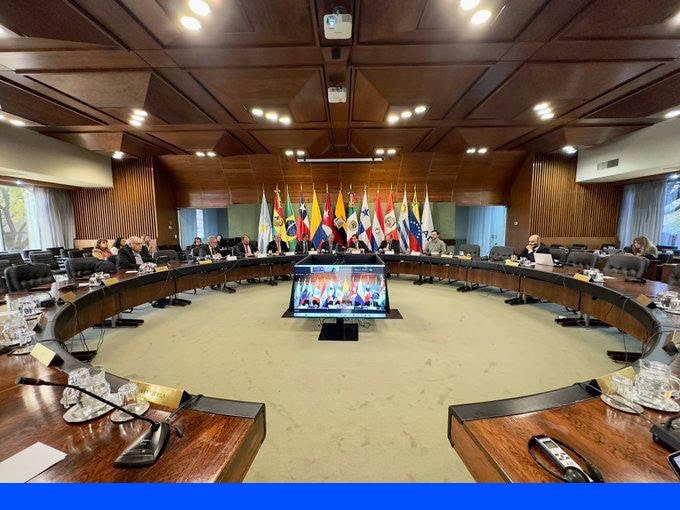

Organized by the Latin American Integration Association (ALADI), the Second Meeting on Bioceanic Corridors was held this week, with the presence of officials from countries, international organizations and the private sector.
The meeting was presented by Rodrigo Hume Figueroa (President of the Committee of Representatives and Permanent Representative of Chile to ALADI) and Sergio Abreu (Secretary General of ALADI). “The event aims to strengthen multimodal transport, infrastructure and logistics in the region, as well as achieve an articulation of regulations related to international transport, seeking to reduce asymmetries in infrastructure,” Hume said at the opening.
In that line, Sergio Abreu He highlighted the merit of the event linked to productivity and competitiveness. “The region has more than 50% of informal employment”; in this sense, “the social inclusion “This is the great must,” he said. He also stressed the need to correct the reality by urging “to work to advance integration and avoid irrelevance, which is one of the threats we face in the new global world.”
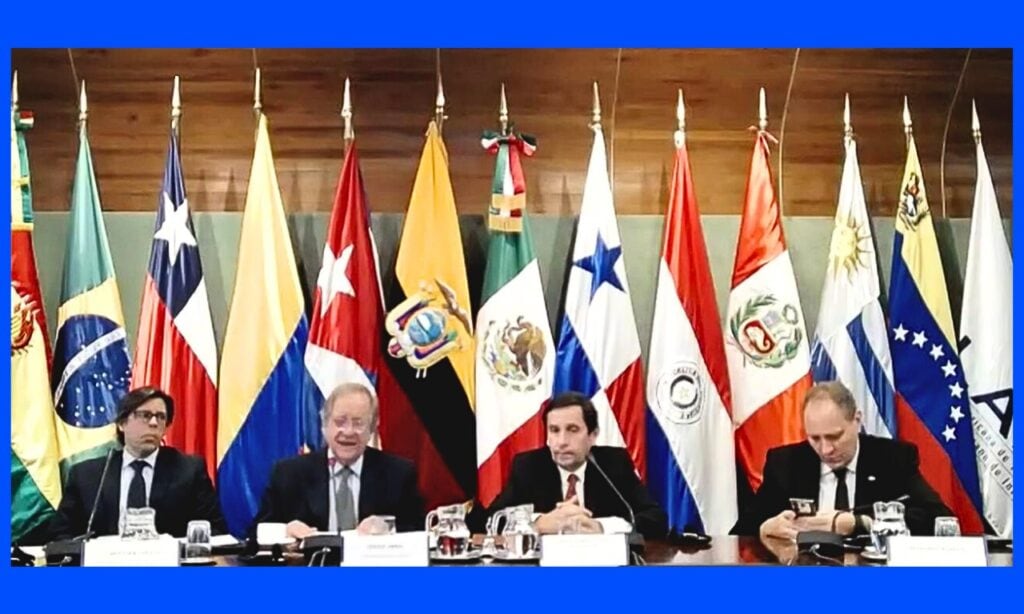
After the inauguration, the meeting was divided into two thematic blocks, both moderated by Christian Leroux (Undersecretary of the Free Trade Area of ALADI).
The first one, titled “Bioceanic Corridors”, aimed to review the experiences of seven countries in formulating modalities regarding how initiatives are being developed.
For its development, it had the participation of Argentina, represented by Francisco Paoltroni (President of the Senate Foreign Relations and Worship Committee) who presented a physical integration project “South American Railways”; Bolivia had as spokesperson Enrique Ponce de León (Vice Minister of Transportation) to address the “Bioceanic Integration Corridor” and the “Lithium Corridor”; Brazil was represented by Jogo Carlos Parkinson de Castro (Head of the Infrastructure Integration Division of the Ministry of Foreign Affairs and National Coordinator of Bioceanic Corridors) to explain the bioceanic corridors and the transformations underway in the face of the new axis of global political-economic development that is the Asian continent. Meanwhile, Luciano Wexell Severo (Undersecretary of Institutional Coordination) shared the “Routes of South American Integration” Project.
The block also participated Chile, whose representative (Sebastián Gómez de Subrei) spoke about the “Bioceanic Road Corridor” (Puerto Murtinho – Ports of northern Chile); Mexico shared the development of the “Interoceanic Corridor of the Isthmus of Tehuantepec”; Paraguay (Fabio Riveros, Planning Director) shared the work he is doing to complete the bioceanic corridor, the axis of integration and development: the Bridge over the Paraguay River between Carmelo Peralta – Puerto Murtinho and Acceso Vial (Br.), as well as the idea of incorporating a new Bridge over the Pilcomayo River between Pozo Hondo and Misión La Paz (Arg.). Finally, Uruguay (Eng. Álvaro Olazábal of the National Logistics Institute of Uruguay) spoke about the challenges of cargo logistics.
The second block entitled “Challenges in relation to coordinated management to facilitate trade” It had the vision of international organizations and the private sector, and sought to offer guidelines and tools to achieve simple, predictable and coordinated border procedures, in order to obtain the benefits of the WTO Trade Facilitation Agreement.
The panelists of this table were Pedro Ángel Flores, Advisor of the Mercator Program of the World Customs Organization; Carolina Rueda, Director of Regional Integration of CIF, and Fernando Ocampo, Principal Specialist of the Trade and Integration Division of IDB.
Added to the previous exhibitors, Juan Couto, Operations Manager of the Customs Hub company, raised the challenge of data interoperability in Customs and Single Window environments when there is no data standardization for Customs Declarations.
Finally, the Second Meeting on Bioceanic Corridors concluded with the reflection of the Permanent Representative of Paraguay to the regional integration body, Didier Olmedo, who highlighted the success of the event, “plausible” due to the participation, the work of the corridors presented, and the political will of the governments to promote projects. Given these positive conditions, he stressed the need to promote a “systemic approach” with multimodal initiatives and digitalization to expand intraregional and extraregional trade opportunities. Hence, the “single window, coordinated border management and inter-institutional coordination” are outstanding reference examples for Latin American countries to implement the framework of the Trade Facilitation Agreement.
It offers the Recording of the Meeting on YouTube

Aduana News foi o primeiro jornal aduaneiro da Argentina a lançar sua versão digital. Com mais de 20 anos de trajetória, suas publicações e iniciativas têm como objetivo oferecer o conhecimento mais relevante sobre temas aduaneiros, contribuindo para a promoção do comércio seguro e da facilitação do comércio na região.