The Argentine Customs announced this Friday (03.03.2023) the creation of a new surveillance sector for the coasts of the Uruguay River, in order to increase controls on regional transfer points, where a concentration of cases of containers contaminated with cocaine has been detected.
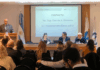
This was stated by the Director General of Customs (DGA), Guillermo Michel, during the meeting held at the headquarters of Customs (City of Buenos Aires) with the federal judge of Concepción del Uruguay, Dr. Pablo Andrés Seró; the federal judge of Victoria, Dr. Federico Martín; the federal judge of Gualeguaychú, Dr. Hernán Viri; the federal judge of Concordia, Dr. Analía Ramponi and the federal prosecutor of Gualeguaychú, Dr. Pedro Rebollo.
The invitation was formally extended to the magistrates to inform them of the actions that Customs is carrying out in the area of drug trafficking prevention.
In addition, Michel spoke of the importance of collaboration between State agencies in this initiative. “We must work in a coordinated manner with security forces, the judiciary and the Public Prosecutor's Office, generating risk perception and reacting quickly to highly dynamic organizations," he said.

Precisely, the head of the DGA explained that "the intelligence The Customs Office has been observing that, in recent times, as a result of the intensification of controls in Buenos Aires, the ports of neighboring countries have become the main regional transshipment points for containers contaminated with cocaine destined for Europe and Africa.”
4 Operatives
According to Argentine Customs, the drug from Paraguay reaches Uruguay in three ways: transshipment containers, small planes and land cargo vehicles. Specifically, he said that in the last few months, four operations found cocaine hidden in trucks trying to cross into the neighboring country. Namely:
- 31,36 kg of cocaine in the driver's cabin
- 56,605 kg of cocaine in the axles of the semi-trailer
- 77,65 kg of cocaine in the double bottom of the semi-trailer floor
- 89,15 kg of cocaine in the front section of the semi-trailer
In fact, the drug could be detected because Customs provided scanners to Columbus, Concordia and Gualeguaychú.
3 Objectives
Given this scenario of attempts to consolidate cocaine in the port of Montevideo, the General Directorate of Customs has three priority objectives in relation to the border crossings of the Uruguay River: search for efficiency, risk perception, rapid response.
3 Places
The operational locations in the region are: Border Crossings of Gualeguaychú-Fray Bentos, Colon-Paysandu, Concordia-Salto (Province: Entre Rios | Bordering country: Uruguay); ports on the Uruguay River (Concepción del Uruguay) and on the Paraná River (Ibicuy) and the Facilities for export in the area.
In concrete terms, the DGA announced that, with these control actions, it will contribute to addressing the problems arising from issues related to organized crime.

Aduana News foi o primeiro jornal aduaneiro da Argentina a lançar sua versão digital. Com mais de 20 anos de trajetória, suas publicações e iniciativas têm como objetivo oferecer o conhecimento mais relevante sobre temas aduaneiros, contribuindo para a promoção do comércio seguro e da facilitação do comércio na região.