Relevant personalities recalled the sixty years of existence of the independent and specialized jurisdictional body in tax and customs matters. This entity, at the national level, is the National Tax Court (TFN).
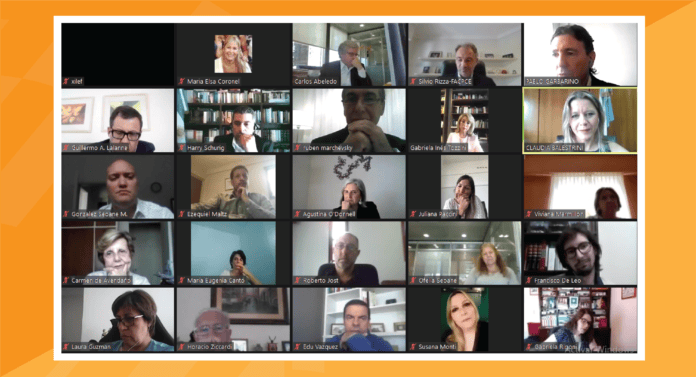
To close the year, on December 2, 2020, the following were summoned to a round table: the President of the Tax Court Rubén Marchevsky, the Ministry of Economy represented by the Undersecretary of Public Revenue Claudia Balestrini, the President of the Federation of Professional Councils Silvio Rizza, the Vice President of Legislative Studies of the Argentine Federation of the College of Lawyers Gabriela Tozzini and the Member of the Tax Court Agustina O'Donnell.
Opening the last meeting of the Commission of Tax Courts, Carlos Abeledo, President of the Argentine Association of Fiscal Studies (AAEF) announced: “This is the first tribute to the 60th anniversary of the Tax Court adapted to the times in which we live., but next year we will be holding face-to-face events with the respective tributes.”
Citizens' Court
“In these sixty years, no one can claim ownership of the jurisdictional body that is within the orbit of the National Executive Power. The National Tax Court belongs to the people of the Nation,” said Judge Pablo Garbarino, organizer of the meeting, in his introductory remarks.
In that line, the Undersecretary of Public Revenue, Claudia Balestrini, He commented on the TFN's view from the public service. “The Undersecretariat of Public Revenue, a dependency of the Treasury Department of the Ministry of Economy, is in charge of the tutelary control of the TFN. This function implies that the jurisdictional body grows,” said the official. And explained the policies To this end: “We are seeking a more dynamic TFN. We must take advantage of digitalisation, as well as oral expression. Changes will be incremental through public policies aimed at gender equality, equality in rights and guarantees and transparency.”
"The vision of the Undersecretariat is an open government with access to public information, participation of the private sector and a federal sense. This will ensure the citizens' guarantees," he said.
Court looking to the future
"Human resources are fundamental for us. This element is key to looking at the future of the National Tax Court.", said its current President, Rubén Marchevsky, who reflected on the origins of the technical body created to resolve issues of acts emanating from the AFIP (General Tax Directorate and General Customs Directorate).
Marchevsky said that the National Tax Court, created by Law 15.265 during the Presidency of Arturo Frondizi, began to operate on April 28, 1960, to "impose before it the resources and demands that said law authorizes."
According to his message, this specialized court in tax and customs matters, unique in Argentina, was made up of four lawyers and two doctors in Economic Sciences. “This is important because from the beginning the value of resolving disputes between taxpayers and the treasury in an interdisciplinary manner was recognized,” he added.
“After sixty years of history, The TFN mission needs another dynamic. “Times change,” the president stressed. “This is a federal court, but federalization was achieved with the electronic file in 2019.” During the initial eighteen months, the implementation of the electronic file within the country, in tax matters, was 65% and 55% in customs matters,” he explained.
The pandemic accelerated digitalization. Thus, the head of the TFN listed the measures implemented:
- Hearings are held by videoconference, avoiding the need for people to travel to the City of Buenos Aires.
- Professional fees are charged via home banking thanks to the agreement between TFN and Banco Nación.
- The TFN appeals before the Chamber of Administrative Litigation have been resolved via email.
- Paper files have a virtual table to avoid physical presence.
- The virtual uploading of judgments in paper files is being streamlined to facilitate public access to government acts.
Looking ahead, Marchevky mentioned the priorities on what should be done to speed up the technical court that he leads:
- Establish an electronic filing system in accordance with the operation of the TFN, or join a system of the Judicial Branch that is useful for the collegiate technical judiciary.
- Manage own resources.
- Hire staff.
- Have your own ranking.
- Consider orality and the use of artificial intelligence in procedures.
- End the building issue to provide decent working conditions for staff.
- Consider incorporating social security competence.
In closing his message, the president of the TFN was emphatic: “We must have our own specialized human resources, professionals who enter the TFN to make a career. For example, people who work in the customs sector end up going to the private sector. Training a new person takes ten years. At the TFN you don't spend, you invest".
Why are there accountants inside the Court?
Silvio Rizza He highlighted the contribution made by accountants in the search for Justice within the specialization of the Court and its character as a technical magistracy. President of the Argentine Federation of Professional Councils of Economic Sciences He argued that "the figure of those registered in the TFN is not for the interpretation of the norm but to act in administrative litigation."
He also called for strengthening the academic training that they receive when collaborating within the TFN in obtaining truth and justice.
Recognition of the right
To Gabriela Tozzini, who are "The origins of the TFN are linked to the imprint of independence from tax litigation, equality and greater respect for justice.«.
After addressing a detailed roadmap for the sixty years, the Vice President of the Argentine Federation of Bar Associations, paid tribute to the TFN in its essence as an independent and specialized jurisdictional body in tax and customs matters, where the solve and repeat, an imperative that is not consistent with the state's respect for individual rights and guarantees.
Gender, an issue of this time
“History is useful for highlighting the high level of tax doctrine that the TFN has developed over its sixty years,” said the Judge of the jurisdictional body, Agustina O'Donnell. According to her, “gender and transparency are issues of this time to be incorporated into the current decisions of the TFN.”
"Their rulings are beautiful processes of accountability for the taxpayer, the treasury and the court, which are available for the public to know.", he said, closing the tribute in exceptional times.

Aduana News foi o primeiro jornal aduaneiro da Argentina a lançar sua versão digital. Com mais de 20 anos de trajetória, suas publicações e iniciativas têm como objetivo oferecer o conhecimento mais relevante sobre temas aduaneiros, contribuindo para a promoção do comércio seguro e da facilitação do comércio na região.