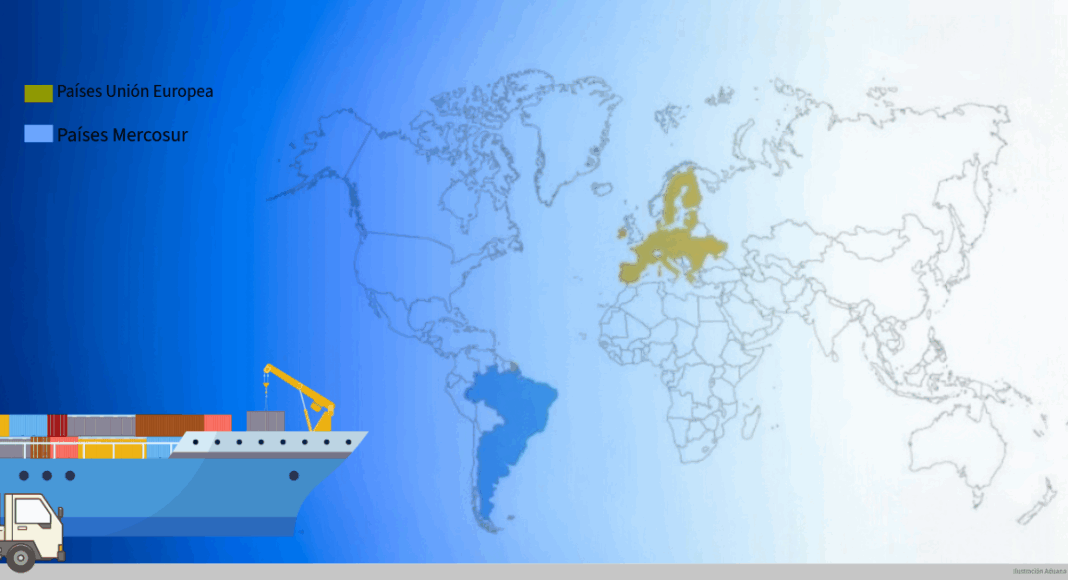

On December 6, 2024, the political announcement of the conclusion of the European Union-MERCOSUR agreement took place at the MERCOSUR Leaders' Summit (Montevideo). This agreement is based on the agreement in principle reached in June 2019, culminating several decades of negotiation. It is pending ratification by all signatory states, after which it will enter into force.
The aforementioned agreement will allow intra-zone merchandise exchanges to take place without trade restrictions and with the almost complete elimination of current customs tariffs.
If we take into account that the customs tariff acts as a production cost in the formation of the prices of goods, we can conclude that the elimination of such tariffs will lead to an immediate reduction in the exchange price of products within the free trade area created by the Agreement, which, depending on the elasticity of demand for said products, will inevitably lead to an increase in their consumption and a corresponding increase in trade between the countries involved.
And one might ask, but have the aforementioned effects always worked this way? In this sense, if we analyze the statistics on the evolution of trade that have occurred as a result of the signing of each of the free trade agreements signed by the European Union over the years, we can see that all of them, without exception, have resulted in double-digit growth in trade between the signatory countries, and that this growth has continued and been maintained over the following years.
For example, if we analyze the statistics on trade between the European Union and the Republic of Korea (signed in 2011), from its entry into force and in all subsequent years to the present day, the volume of trade has grown by more than 10% each year (with the exception of the years affected by the pandemic). This means that the signing of this agreement has contributed to intensifying the economic integration of this area, increasing the wealth and competitiveness of all companies participating in this trade.
Therefore, it is worth considering at this point whether the entry into force of the Agreement signed between the European Union and Mercosur will follow the path of so many other free trade agreements signed by the Community. In my opinion, everything points to that being the case.
As proof that this last statement is correct, it will be sufficient to review the magnitude of this Agreement, and firstly we see that in the previous study carried out by the European Union on the amount of the cost that the elimination of tariffs applicable to imports from Mercosur upon its entry into the European Union would produce on the community finances, it has contemplated that said figure would reach 4.000 million euros each year, or in other words, that all imports of products imported from Mercosur, upon its entry into the Community, will be reduced by the aforementioned amount of 4.000 million euros (remember that the implementation of a customs tariff produces the effect of increasing the costs of obtaining or manufacturing the goods on which it is applied and that therefore its elimination causes its reduction) which will promote greater consumption of the exchanged goods (to a greater or lesser extent depending on the elasticity of demand for each product) with the consequent increase in the commercial flow within the free trade area created by the Agreement, motivating, in turn, the corresponding associated business benefit, the improvement of business competitiveness and the consequent increase in the gross domestic product of the participating countries.
Obviously, these events will affect both sides, including the import of EU products into Mercosur markets. This will create, as we noted earlier, a free trade zone comprised of more than 750 million consumers, where goods will be exchanged between the signatory partners at lower prices, without tariffs or trade restrictions, with the benefits that this alone brings.
But this reality, as outlined above, has a very basic but absolutely necessary condition: that the goods covered by this preferential regime must be produced in the signatory countries and by companies located in that zone, so that the profits generated also remain in that zone.
For this purpose, the concept of origin of goods appears for the first time, which is neither more nor less than the definition of the concept of economic nationality of goods. In other words, we have to determine, through rules or norms included in the Agreement, what we should understand by an originating or national product of the preferential zone created, and to which the rights or benefits derived from said Agreement will be applied.
It is easy to understand that goods that, by the mere fact of being in a country, do not have to be from that country, or in other words, that a good, for example originating or national of China, imported into Argentina, will be in Argentina but will never be originating or national of Argentina and therefore can never have Mercosur origin since, as has been said, it will always be of Chinese origin and therefore cannot benefit from the preferential advantages created for and by the commercial partners that signed the Agreement, unless it complies with the defined rules of origin that allow it to change its origin.
And this concept is fundamental to the application of any preferential agreement, such that tariff preferences must be applied solely and exclusively to goods native to the preferential zone, enabling the benefits to be distributed among the signatory partners. This prevents companies and products from third countries outside the created free trade zone from benefiting from the approved tariff reductions, and prevents this financial effort that each member state must make by not collecting these tariffs from going to third countries with which no agreement has been signed.
With the above groundwork in place, it's time to take a first look at the most basic concepts that anyone interested in the European Union-Mercosur Agreement should know about the origin of goods by analyzing and answering a series of questions, namely:
1. Under the Agreement between the European Union and Mercosur, when will the third-country tariff be applied and when will the preferential tariff be applied?
Some believe that the entry into force of the Agreement will lead to the widespread and automatic application of the preferential tariff, which is far from the truth.
To understand the situation, it's best to look at an example: Should goods exported from Argentina to the European Union upon entering the EU's customs territory be subject to the common external tariff or, on the contrary, to the preferential tariff established under the Mercosur Agreement?
Well, to this question, we must answer that the general rule is that imports in this case will entail the application of third-country tariffs, unless it is declared and can be proven that the goods exported from Argentina are, in the terms defined by the Agreement, originating in Argentina or Mercosur, and only in this case will they be eligible for the tariff reduction.
Therefore, it would be incorrect to assume that all exports from Mercosur will benefit from the zero or reduced rate applicable within the preferential framework, and that only those who can prove their preferential origin will benefit. It will therefore be essential for companies in Mercosur and the European Union to understand these rules so they can adapt their production to these requirements and benefit from the corresponding tariff reduction.
2. How will the benefits that the signatory states of the European Union Agreement with Mercosur obtain be articulated?
The European Union-Mercosur Agreement establishes a series of tariff and other benefits applicable to trade between the two parties, provided that the requirements set forth in the Agreement are met.
The agreed benefits are as follows:
A.Prohibition or reduction of customs duties.
Except as otherwise provided in this Agreement, customs duties applicable to all goods originating in either Party shall be prohibited or reduced.
It must be made clear that the Agreement expressly establishes this benefit, but with the exclusive limitation and reference to goods with originating status defined in the Agreement itself.
B.Prohibition of export duties, taxes and other charges.
The Agreement provides that, generally and subject to agreed exceptions, neither Party may adopt or maintain any duty, tax, or other charge applied to or in connection with the export of any good of the other Party.
Nor may it impose any internal tax or other charge on exported goods that is greater than the tax or charge that would be applied to similar goods intended for domestic consumption.
C.Prohibition of fees and formalities.
Taxes and other charges applied to the importation or exportation of goods between the parties shall be limited to the approximate cost of the services rendered and shall not constitute indirect protection of domestic products or be applied to imports or exports for tax purposes.
D.Allowable charges and rates.
The Agreement expressly provides for the possibility of imposing charges or recovering costs only in the case of specific services being provided, citing, among others, the following:
-
-
- In cases where assistance from customs personnel is requested outside of official business hours.
- In the request for expert analysis of goods and postal rates.
- In cases of examination of merchandise samples for verification or destruction purposes, in cases where costs other than the use of customs personnel are incurred.
- When measures are taken exceptional control measures arising from the nature of the goods or potential risks.
-
3. What is the purpose of the rules of origin included in the Agreement?
The objective of the rules of origin included in the Agreement between the European Union and Mercosur is to establish the provisions that determine the origin or nationality of goods for the purposes of applying preferential tariff treatment and to establish related procedures regarding origin in such a way as to enable trade exchanges with exemption from the payment of tariff duties.
In this regulation, we will find not only the definition of origin for each production, business, or industrial activity, but also the requirements necessary for its application, the mechanisms for monitoring and controlling compliance, as well as administrative cooperation between customs administrations and authorized agencies of both parties, all of which contribute to the correct implementation of the aforementioned Trade Agreement.
4.How is preferential origin acquired?
As previously stated, for goods to qualify for preferential tariff treatment, and provided that the resulting products meet all other requirements established by the rules of origin, they must comply with the production processes that, for the acquisition of origin, are provided for and established in the Agreement and which can be classified as follows:
A.Pproducts wholly obtained in a part of the Agreement.
This is by far the easiest concept of origin to understand. It includes all products obtained naturally, as they occur in nature, or, at most, with a minimal degree of industrial activity.
Thus, for example, an agricultural product will be obtained entirely in the country where it was harvested, a mineral will be obtained entirely in the country where the mine is located, and so on.
B.Products produced in a part exclusively from materials originating in that part.
Thus, for example, if we manufacture a can of vegetables from vegetables obtained entirely in a country, we will obtain a product that is 100% originating in that country under the terms defined in this section.
C.Product-specific rules of origin.
Product-specific rules of origin represent perhaps the most important and sensitive part of the entire preferential origin regulations governing preferential relations between the European Union and Mercosur.
The content of these standards includes the legal mandate of what each producer, manufacturer, or processor must do so that the product obtained from that transformation is considered to be originating in terms of the application of the convention in question.
Therefore, non-originating materials will be considered to have been sufficiently worked or processed when the conditions set out in the list attached to the Agreement are met. These conditions indicate, for all products covered by the Agreement, the working or processing that must be carried out on the non-originating materials used in the manufacture of those products so that the product resulting from such processing may be considered originating under the terms of the Agreement.
Ultimately, it is about specifying what type of processing or transformation a company must carry out so that its finished products (obtained from non-originating inputs or raw materials) can be considered originating and, thus, qualify for the preferential treatment provided for in the Agreement.
The aforementioned Annex includes all goods that may be subject to international exchange classified from Chapter I of the Harmonized System to Chapter 97, and expresses for each tariff item in a clear, simple and complete manner what is understood by an originating product for the purposes of the Agreement and, therefore, what each company must do to ensure that its production is originating for preferential purposes.
5.What does the Agreement mean by INSUFFICIENT TRANSFORMATION?
Once we have defined the concept of a wholly obtained product and that of substantial or sufficient transformation to confer preferential origin, the Agreement completes the regulatory circle of preferential origin by defining a series of particularly simple and straightforward operations, with very little added value and on which the legislator makes a very forceful statement by saying that they “never” confer preferential origin, which means that if in a production process what the processing company carries out is one of these transformations defined as simple, it must know, without any doubt, that it will never be able to benefit from the tariff reduction granted by preferential origin.
In this sense, the following are classified as insufficient operations according to the Agreement: preservation operations such as drying, freezing, preservation in brine or other similar operations, operations of dividing or grouping packages, washing, cleaning, removing dust, rust, oil, paint, ironing or pressing textiles and a whole range of similar operations exhaustively listed in the Agreement.
6.Is justification of preferential origin necessary to obtain the tariff benefits of the Agreement?
Regarding the justification for preferential origin, it can be stated that the need or obligation to provide such accreditation has been a common constant in all the preferential agreements that the European Union has signed with all its trading partners throughout its history.
Traditionally, in the aforementioned preferential agreements, the aforementioned accreditation of preferential origin has been materialized through the use of two mechanisms, the first and most frequent, through the issuance of a EUR-1 model movement certificate, generally issued by the customs authority, and the second, through a diligence issued by the exporter and declaring preferential origin included in the commercial invoice or any other similar document.
However, since the publication of the Green Paper on Origin published in 2004 by the European Commission and signed not only by the authorities of the Union and the Member States but also by representatives of economic operators including customs representatives and customs agents, the possibility of justifying preferential origin by means of a EUR-1 certificate of origin issued by the customs authorities or an authorized body has practically disappeared in the agreements signed since then by the Union, leaving as the only procedure for justifying preferential origin the diligence in an invoice or similar document also known as "communication of origin" and which turns out to be the only possibility enabled to justify the origin within the framework of the Agreement between the European Union and Mercosur.
7.The necessary administrative cooperation.
Based on the fact that the only country that has all the necessary evidence to verify compliance with the rules of origin included in the Agreement is the country of production or export, and in order to guarantee the correct application of these rules, each of the signatory parties undertakes to provide mutual assistance and to cooperate administratively through its customs authorities and competent bodies, with the aim of being able to verify whether a product originates or not from the preferential zone, and whether or not it meets the other requirements established in the aforementioned preferential origin regulations.


The author holds a degree in Law and is a lawyer from the Complutense University of Madrid. He currently works as an Inspector for the State Agency for Tax Administration (AEAT) and is the former Administrator of the Customs of Coslada and Barajas (Spain). He is also a consultant for the Inter-American Development Bank (IDB).