
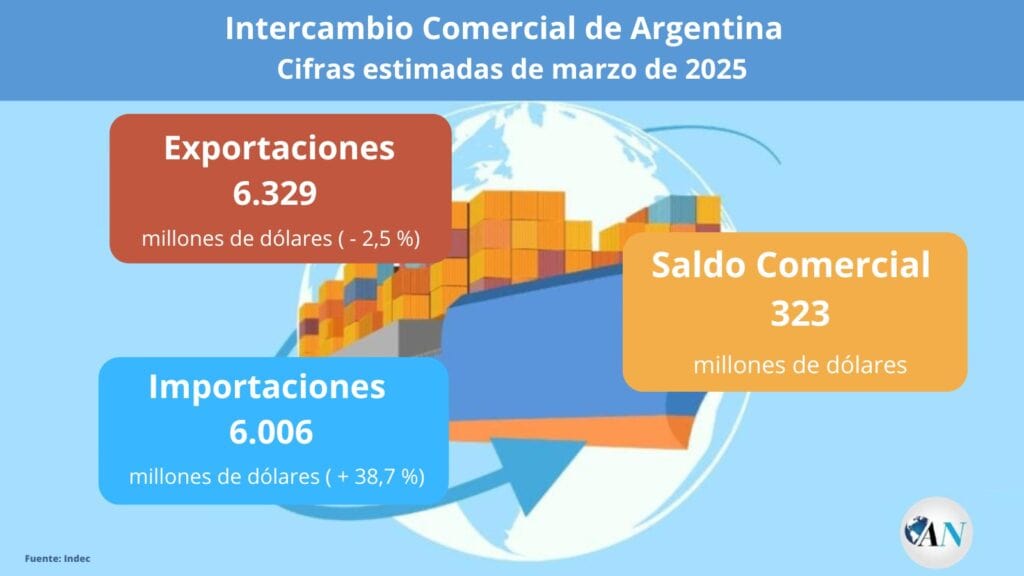
In March, Argentina recorded a trade surplus of USD 323 million, which represents a drop of 84,3% compared to the same month in 2024, when the positive balance had reached USD 2.160 billion.
Despite the sharp year-on-year decline, the result was favorable for the sixteenth consecutive month, according to a recent report by INDEC.
In monthly terms, the March surplus reflected a 42,3% improvement compared to February, when the trade balance had shown a surplus of USD 227 million.
exports totaled USD 6.329 billion in March, representing a 2,5% year-over-year drop. This decline was explained by a 4,2% drop in exported quantities, which was not offset by a 1,8% increase in prices.
The main export categories exhibited mixed results. Sales of primary products registered a 16,1% year-on-year drop, while fuel and energy sales fell by 13,5%. In both cases, the decline was explained by lower prices and quantities. In contrast, exports of industrial manufactures increased by 13,1%, driven by an increase in prices (14,1%), although quantities fell by 1%. In the case of agricultural manufactures, quantities increased by 1,2%, offsetting the drop in prices (–0,4%).
Regarding destinations, Argentine exports grew to the United States (33,2%), the European Union (8,4%) and India (14,3%), while they decreased to Mercosur (-4,4%) and China (-14,0%).
imports, For their part, they totaled USD 6.006 million with a year-on-year jump of 38,5% compared to the same month in 2024 due to an increase in quantities (47,5%) as prices decreased (6,0%).
Import values for all economic uses increased. The largest import volumes were passenger motor vehicles (106,2%), fuels and lubricants (75,1%), capital goods (70,9%), parts and accessories (53,3%), and intermediate goods (10,7%).
Purchases from the main origins also grew: Mercosur (20,1%), United States (21,0%), European Union (44,3%), China (86,7%) and India (90,9%).
First trimester
In the first quarter of the year, Argentina accumulated a trade surplus of USD 761 millions, with exports of USD 18.383 million and imports of USD 17.623 million, representing a drop of 82,1% compared to the trade surplus recorded in the same period in 2024.
Despite the year-on-year decline in the trade surplus in March, Argentina managed to maintain a positive balance for the sixteenth consecutive month. The decline in exports, combined with a sharp increase in imports, explains the deterioration in the result compared to 2024. However, industrial exports stood out, showing a monthly improvement compared to February.
In this context, the Master Gustavo Fadda, an international trade specialist, analyzed the factors that explain this performance and offered an overview of the challenges and opportunities facing the country: “The accumulated trade surplus of USD 761 million, although positive, represents a considerable decline compared to 2024. This deterioration is due to a combination of lower export competitiveness and a sharp increase in imports.”
However, he stressed that the scenario also presents clear opportunities:
- Industrial exports on the rise: High value-added sectors, such as industrial and agricultural manufacturing, are consolidating as a strategic platform for diversifying export offerings.
- Geographic diversification: Advancing the consolidation of markets such as the United States, the European Union, and India is key to reducing exposure to the volatility of traditional partners such as China and Mercosur.
- Digital commerce strategies: The incorporation of innovative tools such as cryptocurrencies or digital currencies—including the digital yuan—could optimize transactions and open new markets, providing agility, security, and cost reduction.
In conclusion, Fadda stated that "the first quarter of 2025 reflects a challenging balance for Argentine foreign trade, with mixed signals between the dynamism of certain sectors and persistent structural tensions." He added: "Initiating policies that strengthen competitiveness, promote financial innovation, and consolidate market diversification will be key to sustaining sustainable growth and strengthening the country's position on the global stage."

Aduana News foi o primeiro jornal aduaneiro da Argentina a lançar sua versão digital. Com mais de 20 anos de trajetória, suas publicações e iniciativas têm como objetivo oferecer o conhecimento mais relevante sobre temas aduaneiros, contribuindo para a promoção do comércio seguro e da facilitação do comércio na região.