





Regional strategic vision
This event is shaping up to be one of the most important at the close of 2025. Everything discussed on Friday, November 28, about streamlining trade only makes sense if it is understood in a fundamental context: the bi-oceanic corridors.
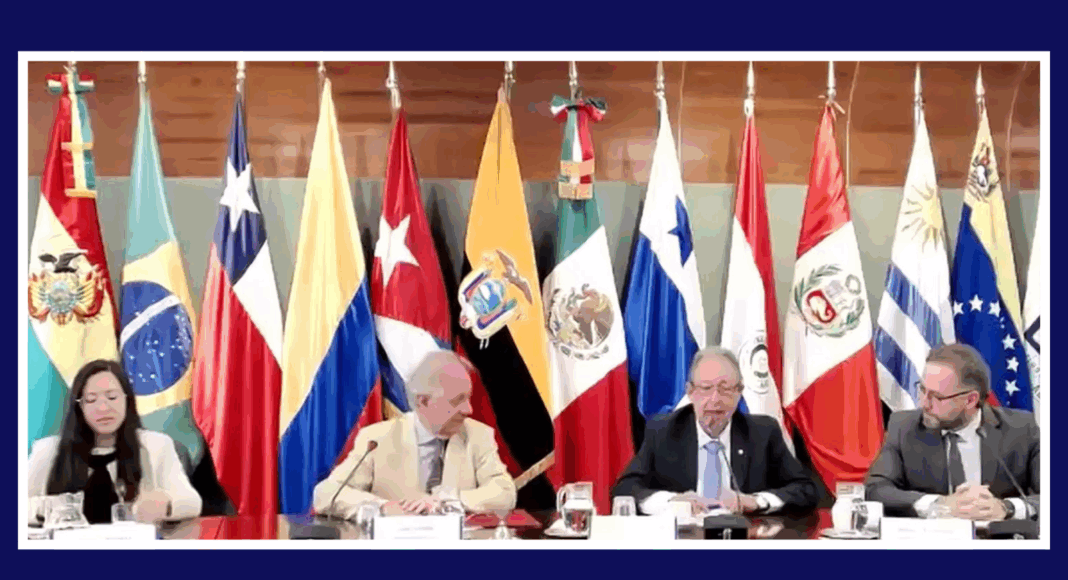
From Montevideo, ALADI organized the "3rd Meeting of Bioceanic Corridors", which brought together authorities, international organizations and representatives of the private sector to discuss progress in connectivity, logistics and regional competitiveness. More from 140 participants They connected virtually. These bi-oceanic corridors connect the Atlantic and Pacific Oceans through Brazil, Paraguay, Argentina, and Chile, with the goal of transforming regional logistics and trade, driving integration and sustainable development by 2026.
The opening was in charge of Ambassador Didier Olmedo, Coordinator of the Transport, Infrastructure and Logistics Group of ALADIHe emphasized that these corridors are a central pillar of the organization's program, integrating trade, regulations, SMEs, and the digital agenda. He highlighted the participation of the private sector, such as FADEAC and the Mato Grosso Industrial Federation. He also noted that the initiative has the support of Resolution 85 of the Council of Ministers, which entrusts ALADI with strengthening regional infrastructure and logistics.
In that sense, the Secretary General of ALADI, Dr. Sergio Abreu, He emphasized the need to reduce infrastructure disparities, especially in Mediterranean countries and those with less economic development. He warned about the region's historical debt and noted that competitiveness depends not only on production but also on logistics and the ability to deliver on time. He pointed out that Latin America must develop its own strategy to address global changes and that attracting investment requires predictability and continuity in structural projects.“If we don’t achieve physical integration, there will be no development, no investment, and no social mobility. Connectivity doesn’t just unite territories: it unites opportunities.”Mr. Abreu concluded, giving the floor to the national authorities present at the meeting.
Progress and opportunities
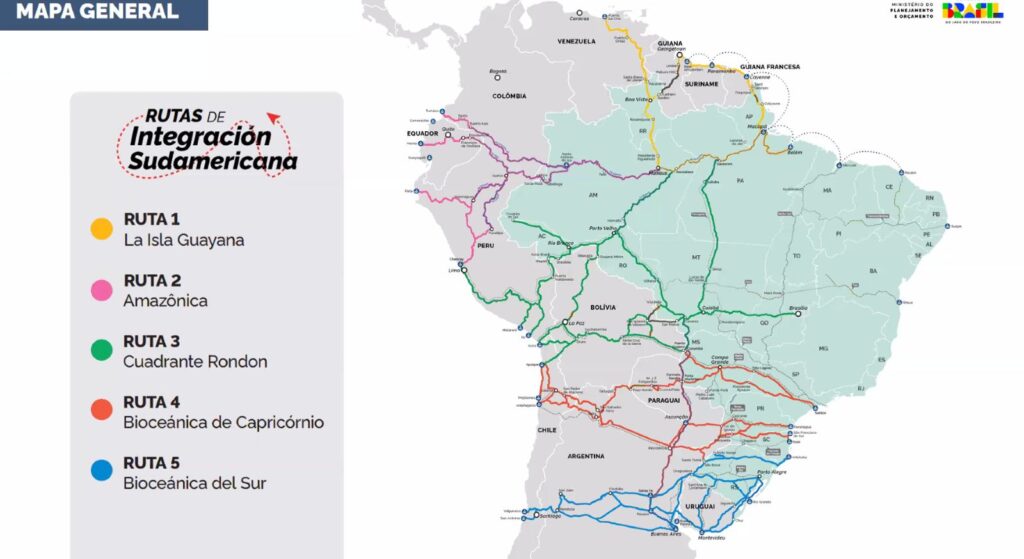
The announced ideas don't remain at the conceptual level: they are translated into concrete projects such as the Capricorn Bi-Oceanic Corridor (CBC)This initiative has historical roots dating back to the 1960s and its current momentum is based on concrete agreements, such as the 2015 Asunción Declaration and the 2017 Brasilia Declaration, which set the shared roadmap between Argentina, Brazil, Chile, and Paraguay. Within this framework, the authorities of Argentina and Brazil participated.
El Argentine Minister Santiago Villarba, Director of Boundaries and Borders and National Coordinator of the CBC Working Group, He emphasized that the corridor requires “a stable coordination system, with thematic working groups and a Subnational States Forum that integrates local and national capacities.” He noted the progress in road infrastructure, where freight traffic still passes through precarious areas, and asserted that the investments will allow for “a qualitative leap” in regional logistics.
Villarba also highlighted the tourism potential of the route, which will connect the Atacama Desert, the Pantanal and various Argentine regions, and explained that the project includes the simplification of border procedures in strategic steps , the Jama (Argentina–Chile), SICO (Argentina-Chile), La Paz–Pozo Hondo (Argentina–Paraguay) and the future bi-oceanic bridgeA specific project under construction on the Paraguay River that will connect Carmelo Peralta (Paraguay) and Puerto Murtinho (Brazil)all key elements for trade between the Atlantic and the Pacific.
To that effect, the minister highlighted the advances of SINTIA, the electronic system that streamlines customs procedures and strengthens inter-customs cooperation, and concluded that The CBC is an integrated project that responds to a growing demand, especially in Southeast Asia, but also towards the west coast of the United States.”, and that coordination with subnational governments, the IDB and national technical teams demonstrates that achieving concrete objectives is possible when physical and digital integration advance together.
For its part, João Carlos Parkinson de Castro, career diplomat in the Brazilian Ministry of Foreign Affairs, He concluded his remarks by highlighting that the Bioceanic Corridor not only seeks to improve regional competitiveness, but also constitutes “a response to the challenges of the current global situation,” offering “greater geopolitical security for our commercial operators.”He emphasized that, once inaugurated in 2025, the corridor will allow Paraguay, Brazil, Argentina, and Chile to be “less dependent on the Panama Canal and other international routes,” reducing logistical vulnerabilities. This greater autonomy, he added, requires “a new perspective on border situations,” providing them with greater legal security, geopolitical stability, and improved living conditions for local communities.
Additionally, Parkinson pointed out the current transportation challenges in Brazil, with high costs, especially in the south, which limits the supply of South American products to Asia. In this context, the corridor will offer “a more attractive logistical alternative” for accessing a market of approximately one billion consumers, with a focus on China. He also highlighted andthe potential for production chains associated with the project: wholesale and retail trade, fuel and repair services, dry ports, logistics, clean energy, customs services, security and digital connectivity, generating new economic activities along the route. As an example of regional dynamism, he recalled that in October 2025 alone, 11.379 companies were established in Mato Grosso, of which 8.500 correspond to the services sector.
Then Murilo Lubambo de Melo, advisor to the Ministry of Foreign Affairs of BrazilHe elaborated on the regional dimension of the project, emphasizing that it is not an isolated corridor, but rather a network of bi-oceanic routes that connects all of South America, with strategic branches towardsto Bolivia, Peru and Uruguay, and a special focus on the western regionHe provided a key piece of information: the program has international financial backing of close to $10.000 billion, intended to accelerate key works of the bi-oceanic system and its complementary connections.
Murilo Lubambo further detailed the digital integration agenda, based on technological convergence at borders and highways, improved connectivity at border crossings, the incorporation of smart infrastructure for transportation, and interoperability between the systems of the countries involved. Regarding trade facilitation, he emphasized that Consolidating the corridor requires progress with instruments such as the digital certificate of origin, the digital signature, the promotion of electronic commerce and the development of shared platforms between customs offices, highlighting that the PROMOMEX study constitutes a fundamental technical input for this agenda.
Master Plan and Regional Cooperation
Following the observations on the Capricorn Bi-Oceanic Corridor (CBC), a question arises: what is needed to move forward? The answer centers on a Regional Master Plan and financing. In this regard, [the following person/organization] intervened Alejandra Radl, integration and trade specialist at INTAL-IDBRadl, who focused his presentation on the CBC Master Plan, defined as “a technical cooperation resource for four countries and the eight subnational governments of the corridor,” emphasized that the essential element is not the route—"already widely known"—but the elements that make this project unique:
- Actor configurationThe presidential declarations of 2015 and 2017 aligned Argentina, Brazil, Chile, and Paraguay, giving rise to coordinated governance between national and subnational levels.
- Sustainable DevelopmentThe project integrates economic, social and environmental dimensions, with a focus on vulnerable communities and the biodiversity of the corridor.
- Three dimensions of the Master Plan: Trade facilitation (optimization of border crossings according to PROCOMEX), physical and digital infrastructure (critical gaps detected by Slot Consulting) and productive and commercial development (mapping of strategic chains and obstacles in certification, innovation and financing).
Regarding the approach territorial-sectoralThe IDB highlighted the need to select strategic products by region to characterize them and understand their gaps, in order to boost their development. For example, in Mato Grosso, Alto Paraguay, Boquerón, and Presidente Hayes, priority is given to...beef, soybeans, cellulose and tourism; in Salta and Jujuy, legumes, tobacco and vegetables; in Antofagasta and Tarapacá, logistics and port services; and in the NOA-NGCH, mining and tourism services.
The plan includes consolidated documentation, a project monitoring system, and a corridor web portal. Governance was formalized at the 6th Campo Grande Forum (February 2025), with a governors' summit, executive committee, thematic committees, and a technical secretariat.
Currently, 16 officials from subnational governments are working in coordination with 15 IDB specialists. Radl concluded by reaffirming the institutional commitment: “The IDB remains fully available to support the implementation of the Master Plan, multi-level coordination, and the investment projects necessary to consolidate the corridor.”".

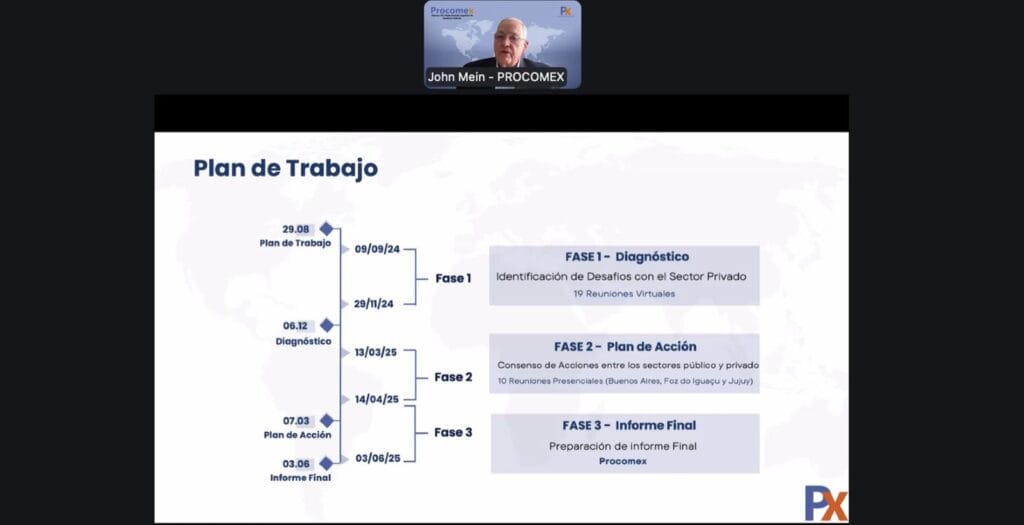
However, the implementation of the Trade Facilitation component of the Master Plan constitutes a key milestone for the consolidation of the Capricorn Bi-Oceanic Corridor, where regional cooperation and public-private integration are essential conditions. In this context, [the following] intervened John Edwin Mein, Executive Coordinator of PROCOMEXwho presented the results of the technical work carried out for the corridor. This study is complemented by the Report of the Coordinated Border Management Project, commissioned by Technical Committee No. 2 “Customs Affairs and Trade Facilitation” of MERCOSUR (CMC).
According to Mr. Mein, the new study was developed in several phases, with virtual and in-person meetings, and involved 465 representatives from the private sector and 161 from the public sector. It allowed for the identification of inefficiencies in regulations, procedures, infrastructure, and human resources, and proposes measures to avoid them in the corridor's new infrastructure.The report emphasizes that “the consolidation of the CBC depends not only on physical infrastructure, but also on the institutional capacity to integrate processes, harmonize regulatory frameworks and guarantee predictability for operatorsAmong the enabling measures, the following stand out: “the digitization of processes, the interoperability of systems, the exchange of scanner images, and the electronic management of customs and health documents,” identifying coordinated border management as a “critical success factor”Mein concluded by emphasizing that “the work turns challenges into opportunities” and constitutes a “results-oriented roadmap to make the CBC a more efficient, modern and competitive corridor.” The full study can be found here: https://drive.google.com/file/d/1nb7Rig-kaG5cuslSy0crU-INEoKCEEyj/view
That said, Rafael Laurentino of ALADI He highlighted that “PROCOMEX’s findings coincide with the lines of work that the organization has been promoting,” emphasizing that “Digitalization is now the central focus of our agendaHe highlighted key advances, such asthe Digital Certificate of Origin, which already covers more than 80% of preferential trade in MERCOSUR and other ALADI countries,” the regional digital signature, with seven integrated countries, and progress in electronic phytosanitary certification.
Furthermore, he recalled the technical studies on Authorized Economic Operators (AEOs), the regional agreements related to transportation, and the seminars on interoperability and risk management. Finally, he reaffirmed the institutional commitment: “The ALADI General Secretariat is fully available to support the Bioceanic Corridor with our experience, networks, and resources.”
One final detail, but no less important: the private sector positions were expressed by Caio Machado, from the Industrial Federation of the State of Mato Grosso (Brazil), who described the challenges and expectations of the region regarding the development of the Bioceanic Corridor; and by Silvia Sudol, from FADEAC (Argentina), who presented the main concerns of the sector and its proposals.
Thus, the meeting offered a space to listen to and articulate the voices of multiple stakeholders. For all the reasons stated above, the 3rd Meeting of Bi-Oceanic Corridors demonstrates that, although a technical topic, it deserves attention. The challenge is to translate the information into actions that strengthen integration, improve infrastructure, facilitate trade, and reinforce digital and logistical coordination, so that the Capricorn Bi-Oceanic Corridor is consolidated as a concrete proposal for sustainable development in Latin America. The complete meeting can be viewed on the ALADI YouTube channel.
Before concluding, allow us a few final words: other relevant and complementary events, such as those organized by the Trade Compliance Institute (TCI), will soon foster synergies to strengthen integration and trade facilitation in the region.
Coverage provided by HUMAN INTELLIGENCE, under the direction of María Elsa Coronel. Total or partial reproduction requires proper attribution.

Aduana News foi o primeiro jornal aduaneiro da Argentina a lançar sua versão digital. Com mais de 20 anos de trajetória, suas publicações e iniciativas têm como objetivo oferecer o conhecimento mais relevante sobre temas aduaneiros, contribuindo para a promoção do comércio seguro e da facilitação do comércio na região.