The lack of business knowledge about the agreement between MERCOSUR and the European Union is a reason for concern in Argentina, in anticipation of the imminent entry into force of the understanding planned for the Friday, May 1, 2026, as warned in an analysis prepared by the consulting firm CIEN, whose author is Master Gustavo Scarpetta.
The survey released this Monday (27.04.2026) to Aduana News It notes that, while companies perceive the agreement as an opportunity with a mostly positive impact, they also acknowledge the existence of associated risks. However, the report warns that, in general terms, The private sector is not prepared for the new business landscape that is coming, highlighting a gap between the perception of opportunities and the actual level of strategic planning.
The data comes from a A survey conducted ten days ago of 190 Argentine companies linked to international trade and specialized consultants, based on five basic questionsRegarding the MERCOSUR-European Union agreement, the analysis highlights a situation that constitutes "a real concern," pointing to a "critical disconnect between reality and perception."
Furthermore, the report highlights that, although the agreement is close to coming into force, most companies mistakenly believe that there is still time, which reveals a marked strategic planning gap.
Highlights
The analysis by the consulting firm CIEN highlights a series of key indicators that reflect the low level of preparedness of the Argentine private sector, namely:
- Knowledge: Only the 10 % Companies are fully aware of the tariff reduction schedule, considered the "operational heart" of the agreement.
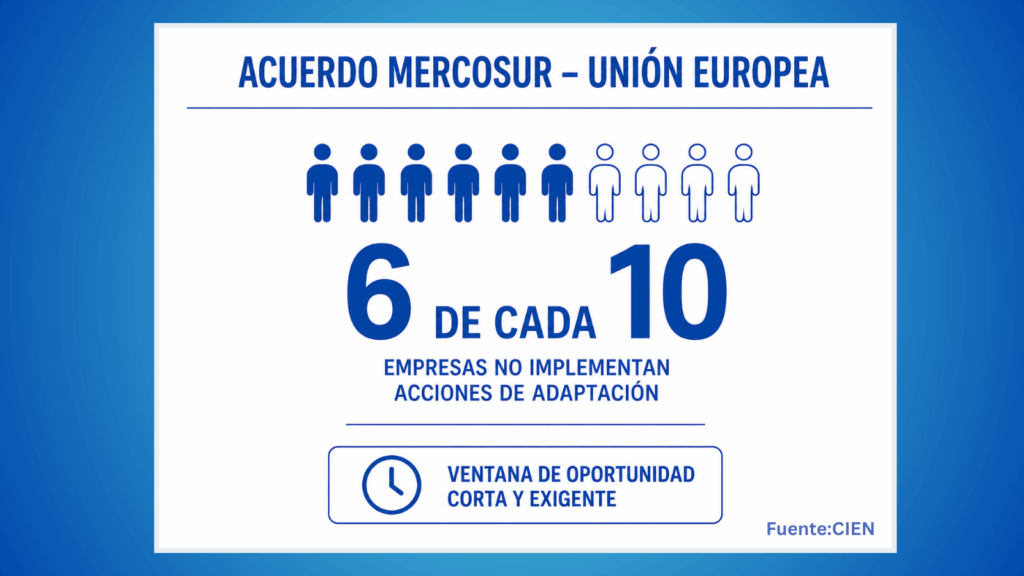
- Action: In turn, almost six out of ten Companies are not implementing concrete adaptation actions, despite the proximity of its entry into force.
- Expectation: Although more than 50 % While many firms perceive the agreement as positive, this expectation has not yet translated into effective strategic planning.
- Strategy: In the same line, six out of ten Companies do not include Europe in their export strategy, despite the imminent opening of the market.
- Gap: The study identifies a deficit of applied business intelligence, evidenced by the low technical knowledge of the agreement and the limited sectoral preparation.
- Risk: This scenario also poses a risk of loss of competitiveness compared to European companies that are already adapted to the new scheme.
The window of opportunity is short and demanding. In this context, the real differentiator, according to Scarpetta, “will be the level of preparation with which companies will face the new commercial scenario, which will begin this Friday.”

Aduana News foi o primeiro jornal aduaneiro da Argentina a lançar sua versão digital. Com mais de 20 anos de trajetória, suas publicações e iniciativas têm como objetivo oferecer o conhecimento mais relevante sobre temas aduaneiros, contribuindo para a promoção do comércio seguro e da facilitação do comércio na região.