Since the 90s, Chile began to implement a profound policy of bilateral trade opening towards the whole world, which has since translated into the signing of 33 treaties and trade agreements with 65 economies, the main ones being those signed with China, the United States, Mercosur and the European Union. In addition, the law establishing tariff preferences for the Least Developed Countries (LDCs) currently covers 48 countries.
In fact, June marked the 20th anniversary of the signing of the FTA with the United States, which took place in 2003 and came into effect on January 1, 2004. But one of the first with an industrialized country was Canada, which signed in 1996.
In these more than two decades, these tools have become an important motorcycler of Chilean foreign trade, being the Rules of Origin One of them is that they allow tariff advantages to be delivered to producers in the destination countries by meeting a series of requirements: they can compete under better conditions if they prove that the product they are exporting is originally from Chile, promoting the development of trade and encouraging investment.
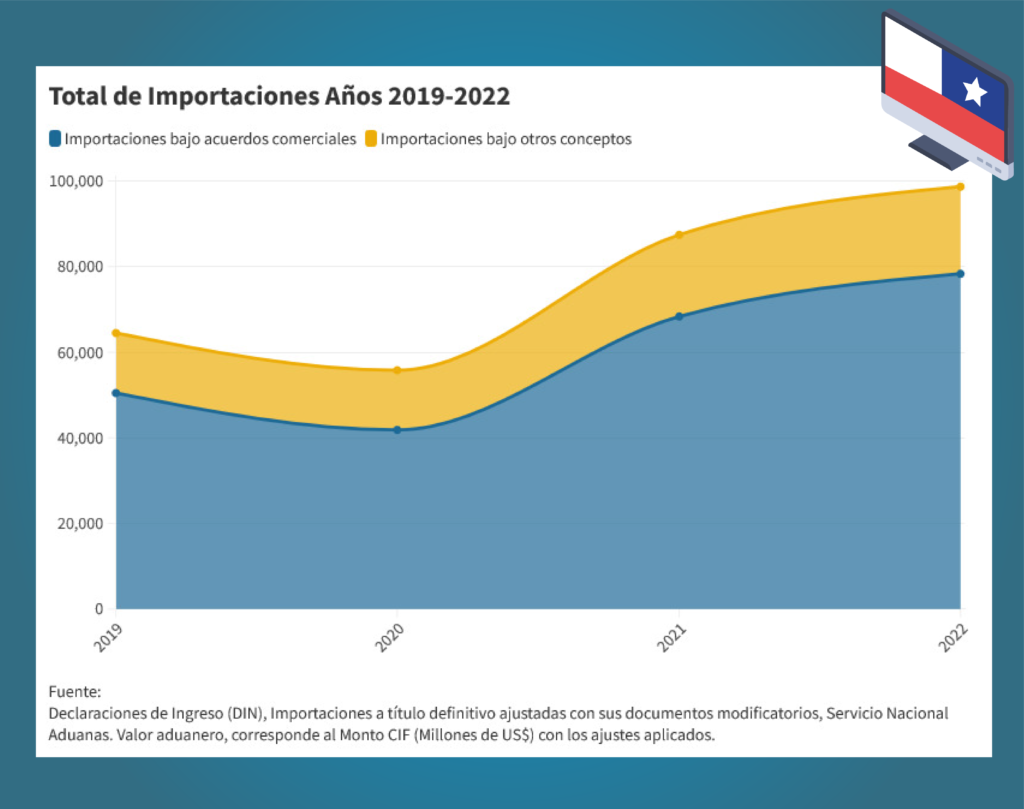
He is such simulator Of the preferential tariffs currently in force, in 2022, 79,4% of Chile's total imports (US$98.673,4 million) were subject to the conditions established by one of the treaties or agreements, which in transaction amount corresponded to US$78.327,2 million. Something similar occurred in 2019 with 78,3% (of the total of US$64.497,6 million); in 2020 with 75% (of the total of US$55.792 million); and in 2021 with 78,2% (of the total of US$87.428,4 million).

El ranking of imports with the use of preferential rates is led by the FTA with China, which for 2022 represented a 25% share (US$19.573,5 million), followed by the FTA with the United States with a 23,2% share (US$18.141,4 million). Next, there is the agreement with Mercosur, which has a 20,1% share (US$15.756,2 million) and the agreement with the European Union with an 11,2% share (US$8.628,1 million).

Why data deserves our attention? The answer to this question lies in the fact that regional integration remains a driving force of the global supply chain and rules of origin remain a prominent feature of the current international trading system.
The National Customs Service of Chile announced that, in this context, the 3rd Global Origin Conference of the World Customs Organization (WCO)The next November 8 and 9 at the Intercontinental Hotel in Santiago
Registrations for this conference are now closed, the organization added. At the moment, the participation of around 100 participants has been confirmed. 400 delegates from around the world, led by WCO Secretary General Kunio Mikuriya, the National Director of Customs, Alejandra Arriaza, and other national directors of Customs from Latin American countries, who will meet in Chile to discuss the future of the Rules of Origin and how they impact the development of foreign trade.
There will be international discussion panels and exchange of experiences with experts, Topics such as: Rules of Origin: the African experience in the international context; Use of Free Trade Agreements; Digitalisation accelerates paperless trade; the place of Rules of Origin in the Ecological Transition; and the future of rules of origin from a global perspective.
Representatives from different Customs authorities around the world, public service authorities, experts from international organizations and representatives from trade unions, companies and the academic world will attend.
Delegates will come from the United States, Canada, Mexico, the Dominican Republic, Uruguay, Guatemala, Ecuador, Brazil, Argentina and Peru, as well as from Ghana, Kenya, South Africa, Angola and Nigeria. Other participants will come from countries such as India, Pakistan, Indonesia, China, Saudi Arabia, Spain, Italy, the United Kingdom, Switzerland, Belgium and Hungary, among others.

Aduana News foi o primeiro jornal aduaneiro da Argentina a lançar sua versão digital. Com mais de 20 anos de trajetória, suas publicações e iniciativas têm como objetivo oferecer o conhecimento mais relevante sobre temas aduaneiros, contribuindo para a promoção do comércio seguro e da facilitação do comércio na região.